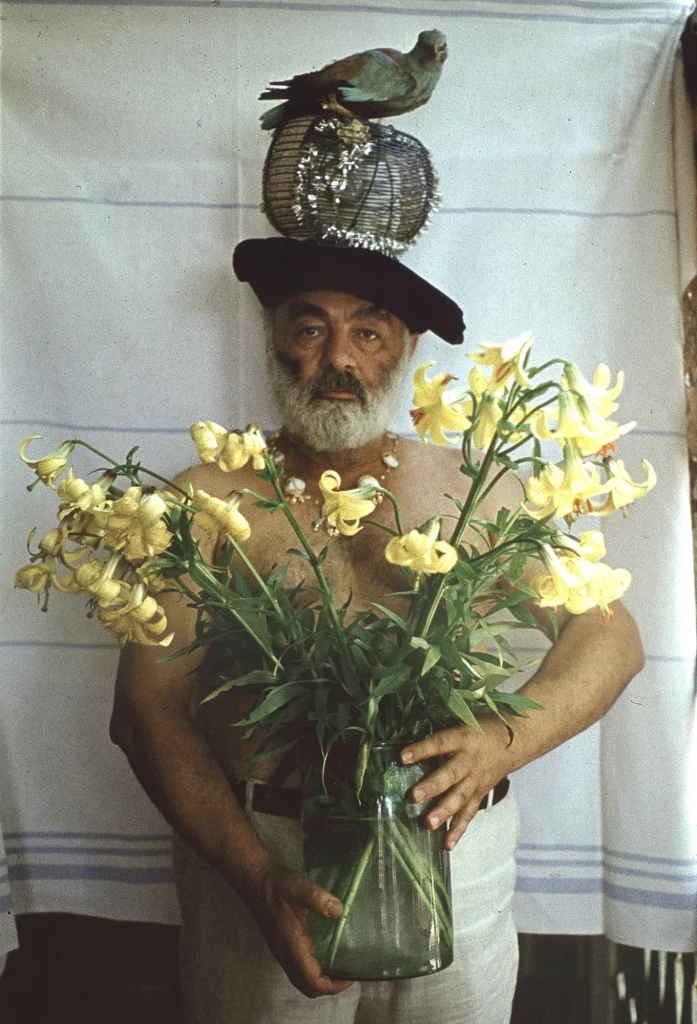
His studio is in London, but the materials he uses for his work come from much further afield: Afghanistan, the United States, Brazil, Iraq, Saudi Arabia, China and, more recently, Ukraine. British artist Piers Secunda has been creating paintings and prints for more than 25 years. His works are held in the collections of leading museums and cultural institutions in the UK, the US and other countries.
Piers began as an abstract artist, but after the 9/11 attacks and the Taliban’s destruction of the Buddhas of Bamiyan, his focus shifted towards the destruction of culture, iconoclasm and the question of why people destroy hings that hold significance for society.
Since then, material has become more than simply a tool for him. He works with materials that are part of a particular history — charcoal, rust, crude oil and other substances connected to places affected by conflict and disaster. In this way, Secunda says, the story begins long before the finished artwork appears.
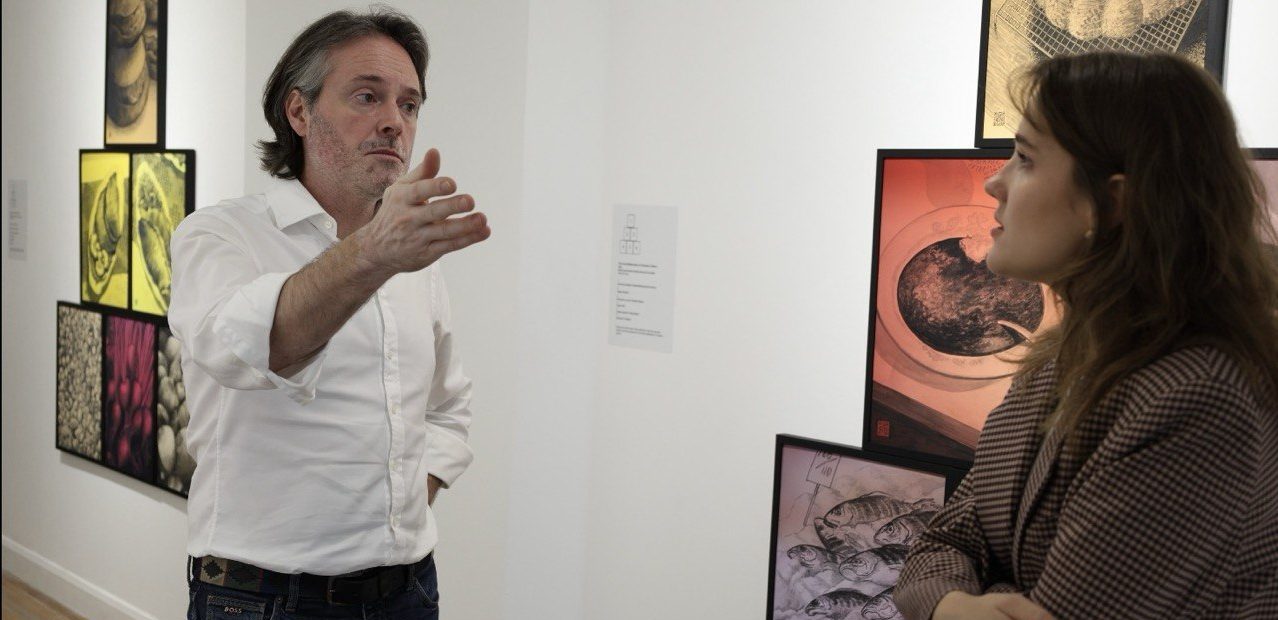
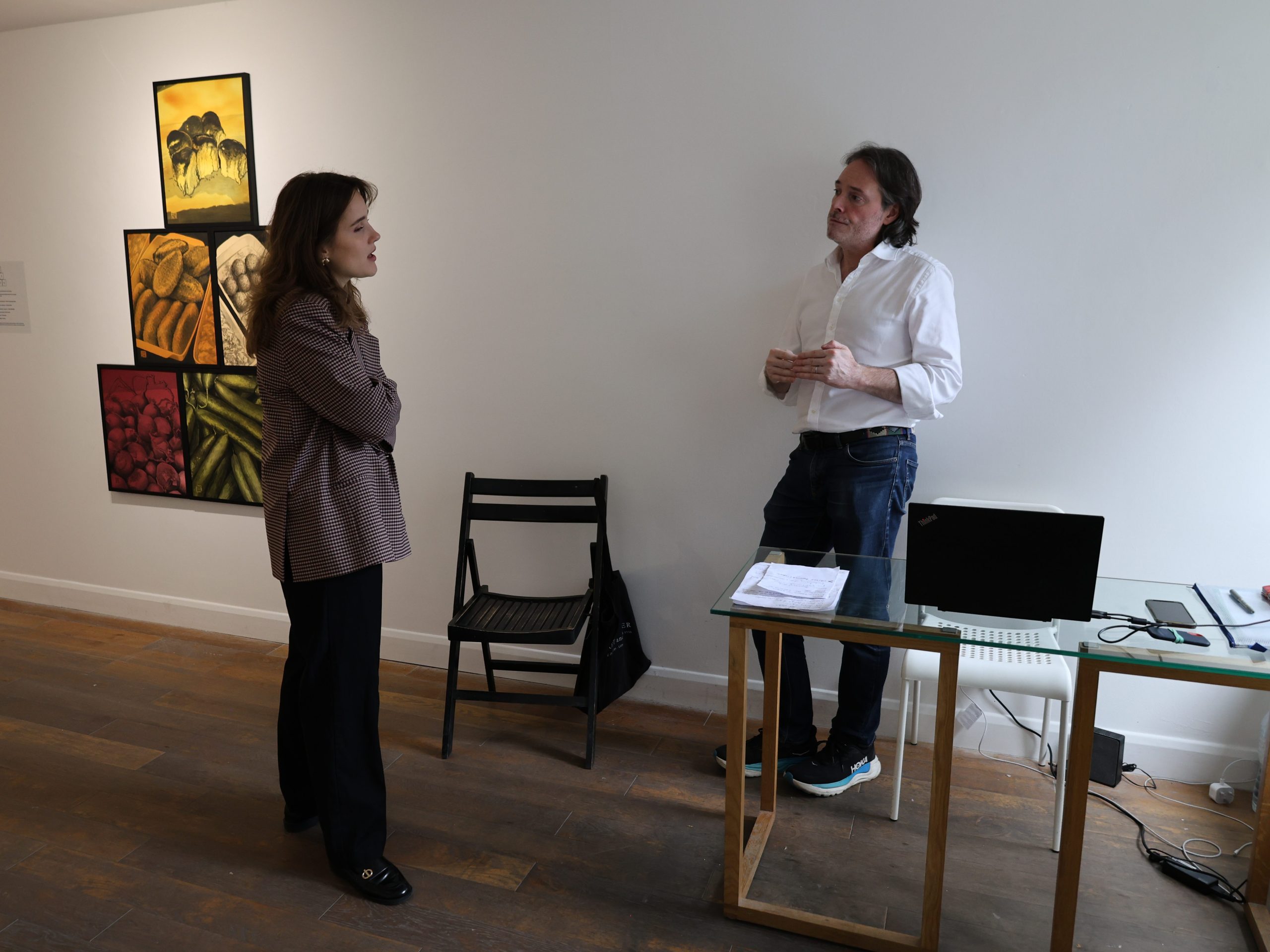
Maiak journalist Karina Volovidnyk visited Piers’s exhibition in London and spoke to the artist about Nature Morte: The Extermination of Ukraine, the idea behind the project and the war crimes he documents through his art.
First Encounter with the Exhibition
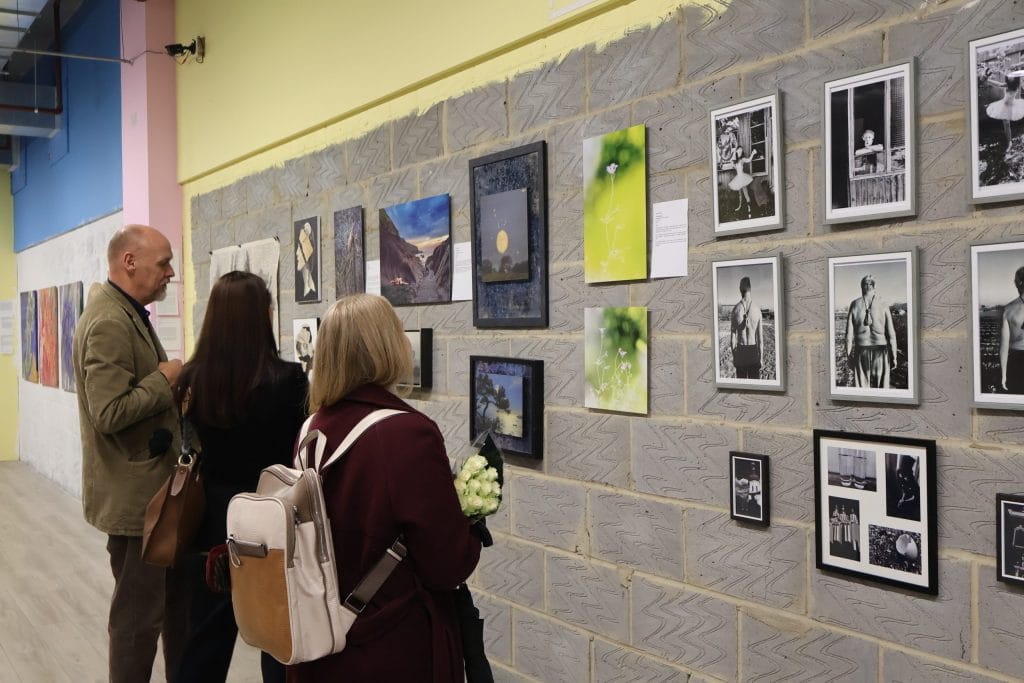
I make my way to a London gallery to meet the artist in person and see what story his paintings are telling this time.
This is a new series of works created after his return from Ukraine. Over the past two years, Piers has been there twice — in 2024 and 2026 — including visits to Kharkiv, Odesa and Kyiv. There, he collected materials, observed, spoke to people and researched how Russia is destroying Ukrainian culture during the war.
While we wait for the interview with the artist, I look around at the works.
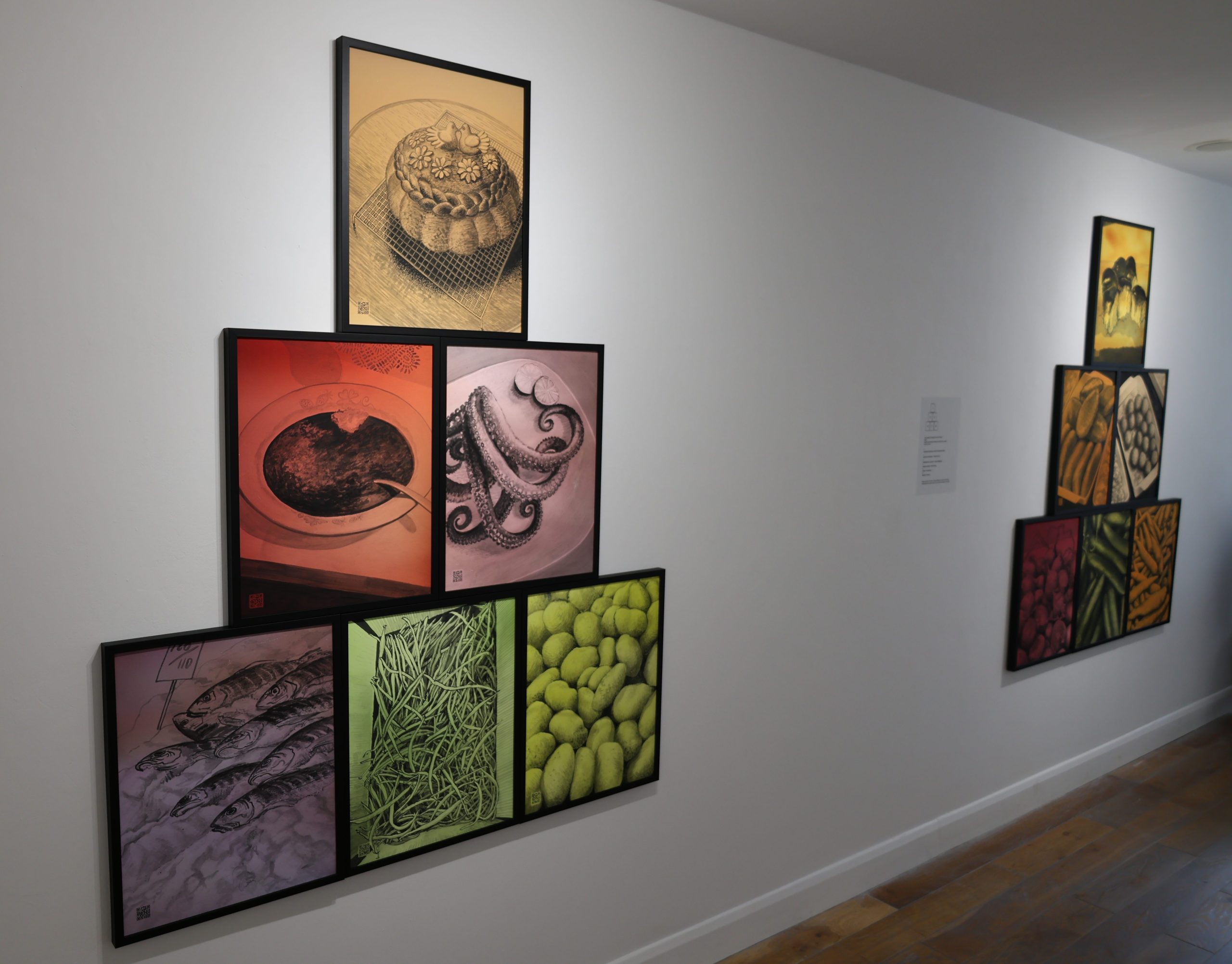
Bread.
Borscht.
Deruny.
Chicken Kyiv.
In one of the paintings, I recognise fish from Odesa’s Pryvoz Market, complete with its distinctive price label. Later, during our conversation, the artist confirms that I was right. In another are pampushky with garlic, familiar to every Ukrainian.
It all looks almost ordinary. Familiar. As though you have simply stepped into a kitchen or wandered through a market.
But the lines in the images make me look more closely. I already know part of their story and why they are such a deep black. And it is not simply a matter of colour.
The ink is made from charcoal collected in Kharkiv at the site of the 2022 Russian missile strike on the Regional State Administration building. In this way, remnants of destruction have acquired a new meaning, helping to depict what the enemy is trying to erase.
Food as a starting point
But why did food become one of the central images of this series? So I put the question to Secunda:
— How did the idea of depicting Ukrainian food in your work come about? Was there a particular moment or experience that prompted you to do it?
— Well, I think that food is the easy one. It is the most accessible image I could come up with. I chose it because the subject of damaged culture, and trying to translate an understanding of that damaged culture into art, is a very complicated process.
At every stage, I try to simplify everything as much as possible. And this is the simplest way I can think of to translate such a detailed and complicated subject into an image that people can understand.
If you walk down the streets of Europe and ask a passer-by, “Have you ever heard of borscht?”, they will say, “Yes.” And if you ask, “What is borscht?”, they might answer, “A Russian soup.”
And that misunderstanding means that even traditional Ukrainian dishes are being Russified. In some way, that balance needs to be restored.
I am not trying to restore that balance myself. I simply use Ukrainian food as a starting point, from which I move towards images that explore the destruction of culture. So the exhibition of my paintings starts with images of raw ingredients, then moves on to prepared dishes — they’re in the middle of the paintings — and then to bread. It’s a kind of pyramid that mirrors the power structure of the people committing war crimes in Ukraine.
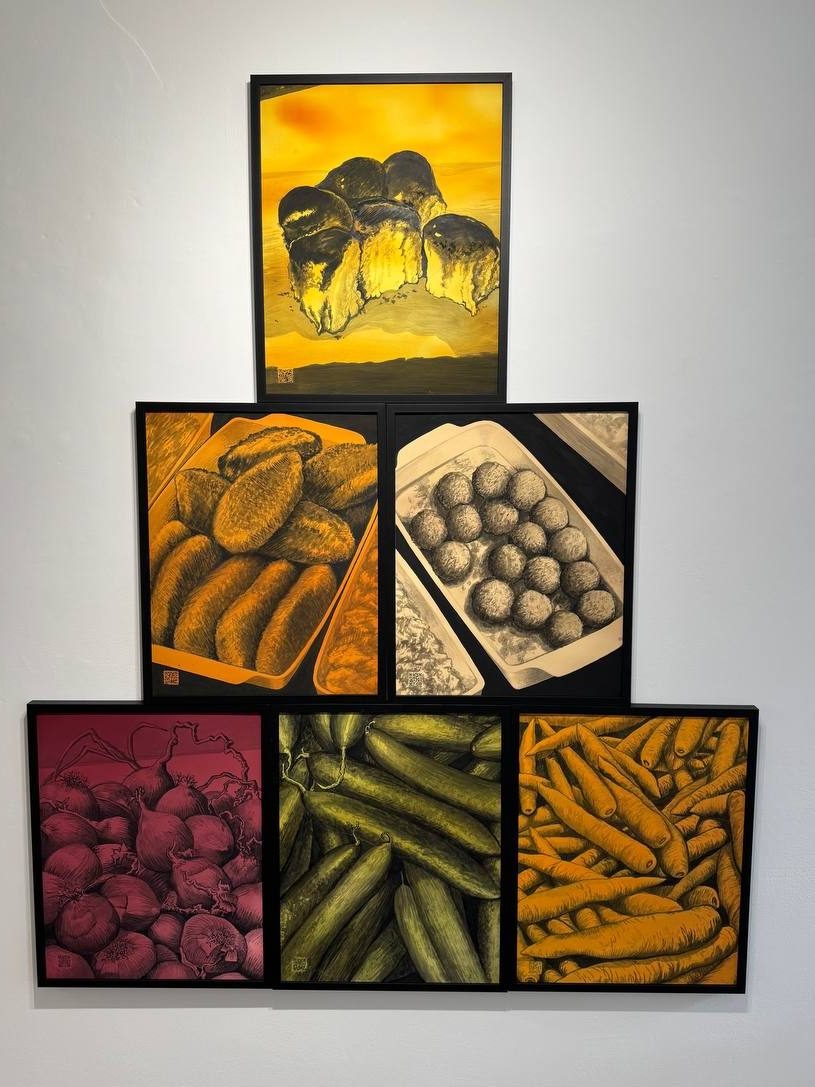
The title of the exhibition sounds considerably harsher than what you see in front of you: Nature Morte: The Extermination of Ukraine. The canvases are filled with bright colours, familiar foods and everyday scenes. For me, as a Ukrainian viewer, that is enough to read much more into them than simply still lifes of food. Behind these images, I recognise my own everyday life and, along with it, the context in which they were created.
But would someone who has never been to Ukraine, and for whom these foods and images carry no particular meaning, see them in the same way? Could the “beauty” of these paintings, on the contrary, make the story behind them feel less immediate?
So I ask the artist whether he worried that by making these paintings aesthetically beautiful, he might soften the reality of what they depict.
— I think it is the simplicity and recognisability, that instinctive understanding people have when they see food, is what draws them into the thought process. And that is very important.
Something that is not decorative, not necessarily beautiful, but easy to understand. Something that catches people’s attention and makes them want to find out more: why am I making paintings of bowls of soup and beans?
Anyone who walks into this gallery can understand that this is grilled octopus, this is fish, these are potatoes, this is borscht, and this is beautiful, decorative wedding bread, korovai. Through that immediate understanding of what the food is, people become engaged.
Everyone asks, “Why are they arranged in the shape of a pyramid?”
If I had not arranged them in a pyramid, people would look out of the window and walk away. But people get curious — why are the foods arranged in this way? And that curiosity engages them, draws them into the discussion and gets them thinking.
When Art Becomes Research: Materials, Perpetrators and Scale
Using charcoal as ink is not a new practice for Piers Secunda. He has worked with the material before — drawing with charcoal from burned buildings in Iraq immediately after their liberation from ISIS, as well as charcoal from trees destroyed by fires in the Amazon.
He has also used other materials: rust from the steel of the World Trade Center after the 9/11 attacks, crude oil, soot from vehicle exhausts, and even gunpowder from German ammunition dating back to the Second World War.
In his Ukrainian series, however, he delves much more deeply into the stories of specific individuals, cultural identity and the impact that destruction has on Ukrainian society.
“The thing about my work relating to Ukraine, which is different from previous projects that I’ve worked on, is that the Ukraine project, for me, an examination of what’s happening in Ukraine as a result of the Russian invasion, is more involved in the nature of people who are carrying out the actions than in any previous project that I’ve done.
So, a large part of the Ukraine project for me, is an attempt to find out who is carrying out the damage, who is in the governmental structures that are bringing about the damage to Ukrainian culture.”
Yet Piers does not leave these stories at the level of simply describing crimes — he seeks to identify the specific people behind them.
Each work is presented without a written description. Instead, beneath it is a QR code leading to a separate digital archive. There are names, photographs and information about Russian officials and military personnel whom his research links to the looting of Ukrainian museums and art collections, the abduction and forced transfer of Ukrainian children to Russian families and their militarisation, as well as, separately, the 2023 missile attack on Odesa Cathedral.
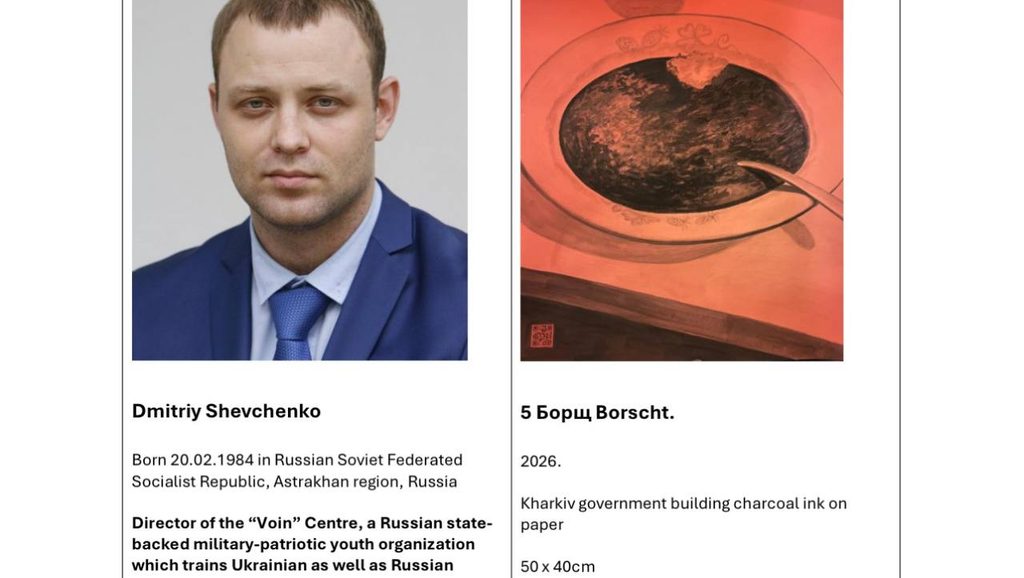
”Part of the point of making these works is for the works to represent, in a slightly poetically abstracted, detached way, individuals.
If they’re going to represent individuals, obviously I have to explain who the individuals are.
The reason I use QR codes to transport people’s minds from a bowl of borscht to a biography of a person is that these paintings are made with charcoal.
Charcoal was the first mark-making implement that human beings used. It’s in cave paintings. The QR codes carry you from the primary use of charcoal, 60 or 70,000 years ago, through the internet age, to data about people who are disassembling the identity of a nation.
I didn’t think that my work would enable that bridge to exist, but it’s very important for me that it does.”
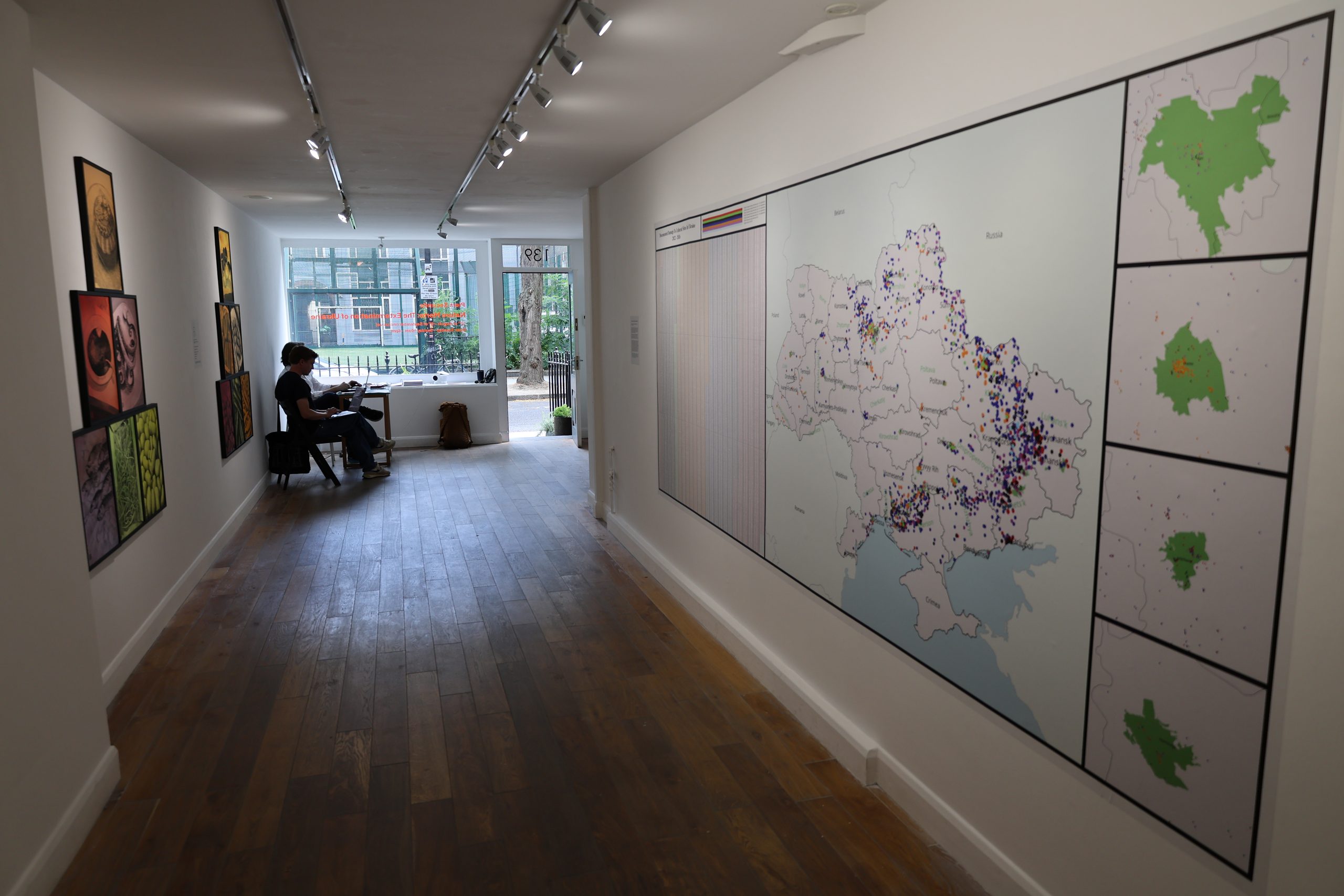
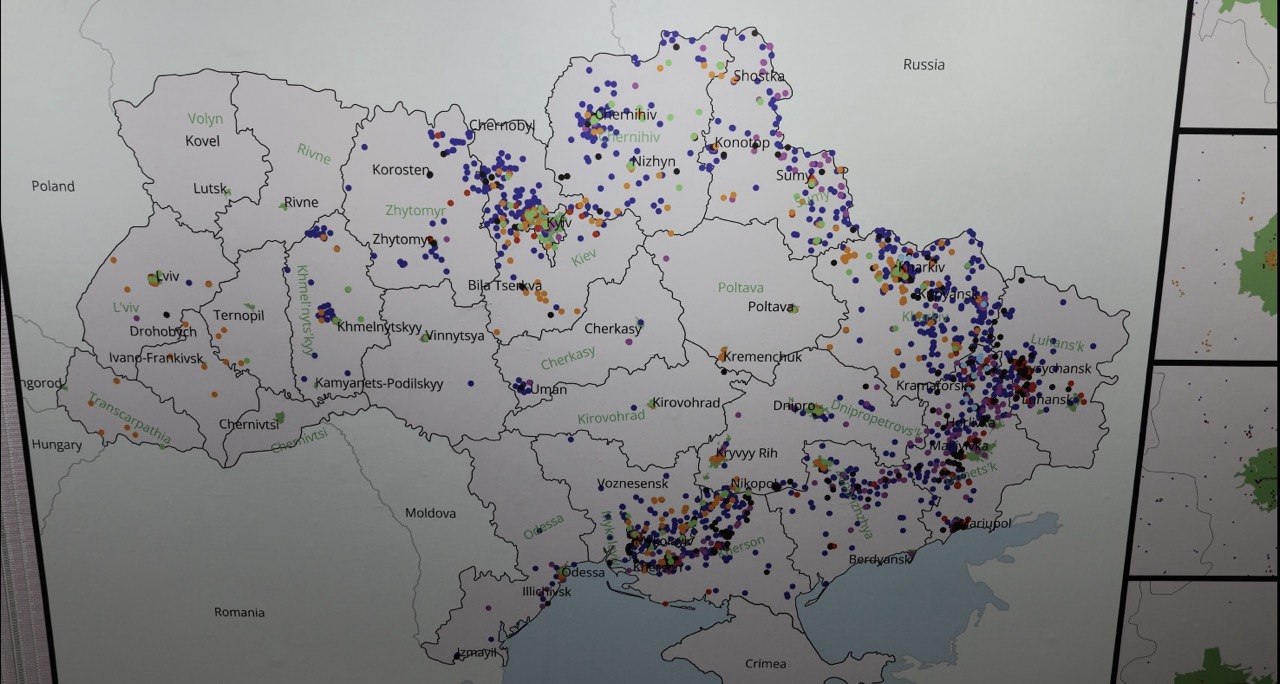
The artist also uses numbers to demonstrate the scale of the damage caused by Russia. On the gallery wall is a visualisation of 6,347 documented cases of damage to Ukrainian cultural sites between 2022 and 2026. Each dot represents an individual case, transforming data into an image that conveys the scale of loss across the country.
The Impetus Behind the Project
Secunda’s work is based not only on documents, archives and years of research. He found some of the answers directly in Ukraine, from people who found themselves at the centre of events.
One such conversation, he says, became the moment when he began to see what was happening to Ukraine’s cultural heritage differently and provided the impetus for this project.
“There was a particular moment on the second day that I was in Ukraine, when I was sitting down in the empty Pinakoteca Museum in Kyiv with Anastasia Cherednychenko, who is the head of ICOM, the International Council of Museums.
I sat down with her and said, ‘I think that there must be a power structure controlling the looting of art.’ And she immediately said, ‘Yes, absolutely, and it’s run by this guy, Yuri.*’ Then a huge understanding opened up right in front of me, which is that what was happening was organised by the government on an industrial scale. It wasn’t something spontaneous — everything had been organised so that valuable things could simply be removed quickly and easily. What I wanted to do was interview a lot of people, get a broad understanding about how the damage to culture was occurring, and then formulate my ideas about what I would make
But in that moment, I realized that these pyramid structures — the power structures that control the looting, and mass deportation of children — if I could find out who the other people were in the pyramid, and Anastasia Cherednychenko already given me one name at the top, then I had an exhibition, and I had a project. I could take it to pieces and decide to rip and rebuild the form of art. That was a very important moment for me.”
*The man referred to as Yuri is Yuri Komlev — director of the Orenburg Regional Museum of Fine Arts and a member of the governing bodies of Russian museum organisations. According to Piers Secunda’s research, he is linked to the coordination of the theft of art from museums in occupied Ukrainian territories.
How International Visitors Respond
All these stories, names and thousands of documented cases come together to form a picture whose scale is difficult to comprehend. But does someone’s perception change when they encounter information they had previously known nothing about?
— So, how do British visitors respond to the exhibition when, perhaps for the first time, they are confronted with the scale of Russian crimes against Ukrainian culture?
— People are generally very shocked. A lot of people in the UK don’t realise that there is a mass deportation of children taking place, or understand the scale of it. They don’t realise that military camps in Russia are turning children into Russian soldiers, or know who runs those camps. They don’t know the names of the people behind it.
But when I tell them it’s the equivalent of the Boy Scouts, a European organisation, but with hand grenades and rocket launchers, that shocks them, and they start to understand what is actually happening.
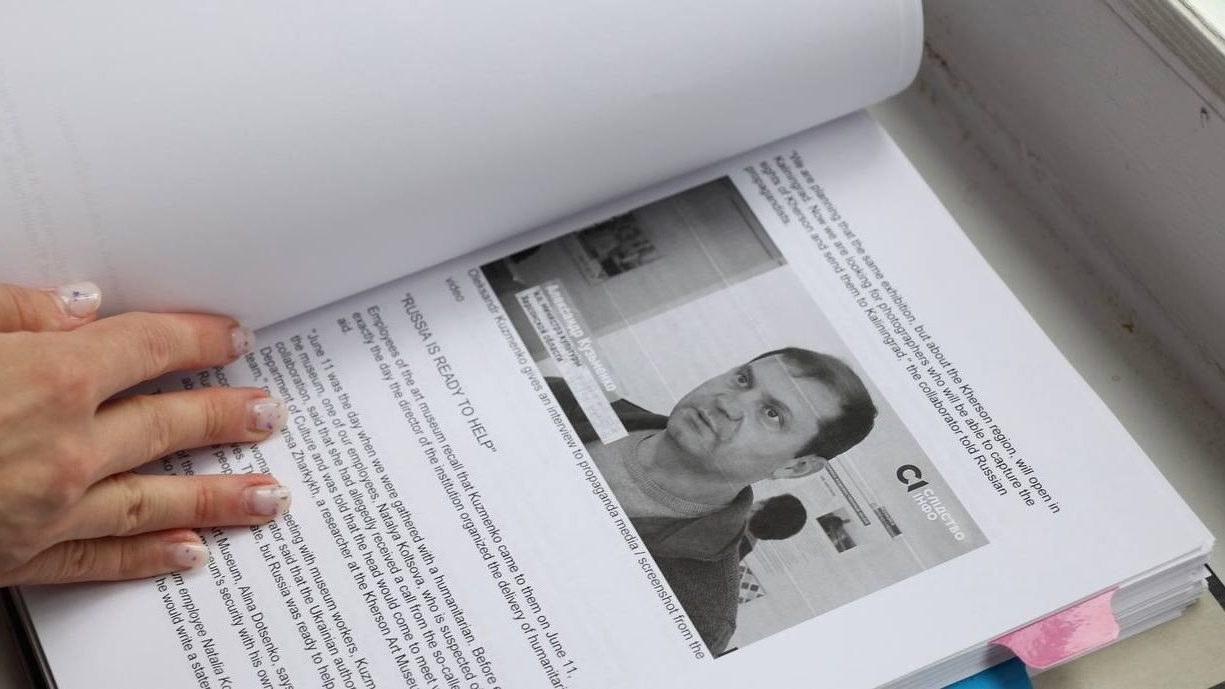
Then I give them the statistics, which I have printed out. All of the QR codes have data relating to these people, and I’ve made that information available on paper as well. If people don’t want to use the QR code, I tell them, ‘Go through that.’
And when they start looking through the material and realise the scale of the militarisation of children and the forced adoption of Ukrainian children, you can see a change in the way they engage with the exhibition and the introductory texts. They start to realise that this is something much, much more frightening than simply one country attacking another.”
The Project Continues: A Film, New Exhibitions and Other Work
The exhibition is not the end point. The artist wants the stories and testimonies gathered here to continue to live after the exhibition closes — this time in the form of a documentary film.
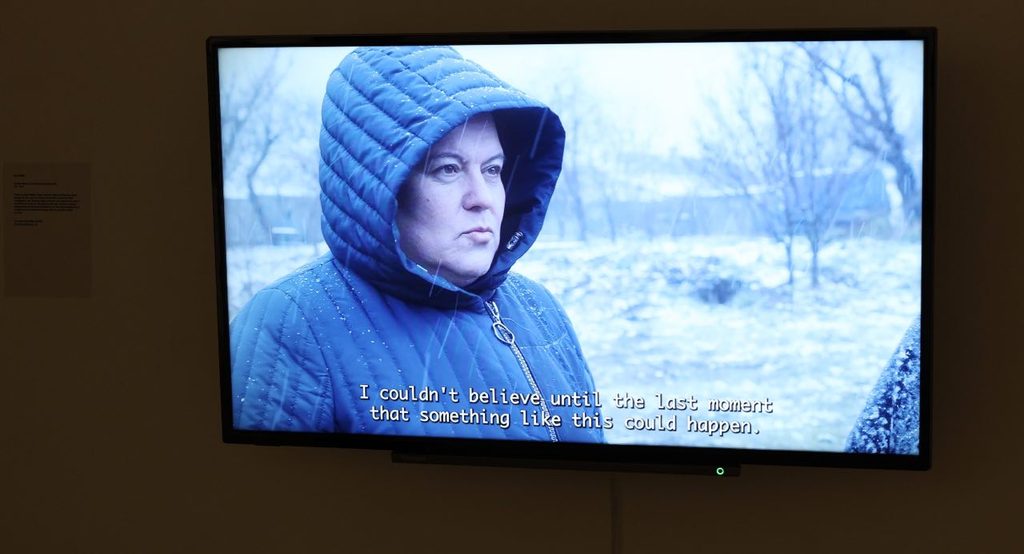
The film is being made by the director, David Miller. Some of the material already produced — including conversations with people recorded during Piers’ research in Ukraine — can be seen at the exhibition itself. Around one hour and twenty minutes of material has already been completed, and work on the film is continuing.
The team needs funding to take the project further, so they plan to launch a fundraising campaign in the near future. Piers also wants to remain in contact with visitors who leave their details and keep them updated about the film’s development.
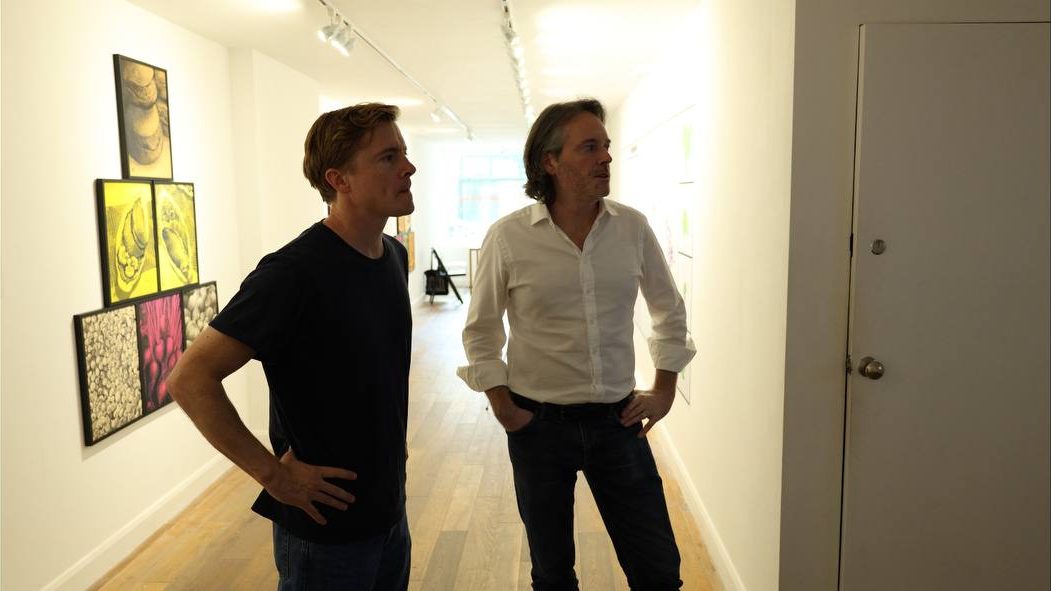
For Piers, London is only one of the places where this story can be heard. He would like to take the exhibition to the United States and is already considering several possibilities for showing it there.
The Ukraine project is not the only subject Piers is working on today. In recent years, he has been creating paintings using soot collected from vehicle exhausts to produce large-scale landscape works. They depict forests, jungles and other natural environments threatened by human activity.
The artist says these works share something with his Ukrainian series: they attract viewers through their beauty while simultaneously carrying a “dark” underlying meaning.
Yet, despite his work on other projects, Ukraine remains a personal story for Piers.
At the end of our conversation, I asked the artist whether he plans to return to Ukraine.
“Yes, absolutely,” he replies.
Secunda says he plans to bring the exhibition to Ukraine itself.
“I sit in fear every morning that I’m going to receive a message saying something’s happened to someone I know in Ukraine [the artist is referring to everyday missile and bombing of Ukraine], and I just want that to end.”
For the artist, this exhibition is not only a way of telling British audiences about what is happening to Ukrainian culture. It is also his personal connection with the people he met in Ukraine.
The exhibition Nature Morte: The Extermination of Ukraine can be visited at Fitzrovia Gallery in London until 6 September 2026. Admission is free.
Some of the works presented in the exhibition are available to purchase. Fifteen per cent of the proceeds from their sale will go towards restoring a damaged 12th-century church on the grounds of the Kyiv-Pechersk Lavra.
Text: Karina Volovidnyk
Editor of the Ukrainian version: Anastasiia Zanuzdanova
Editor of the English version: Helen Lewis
Photography: Svitlana Tun