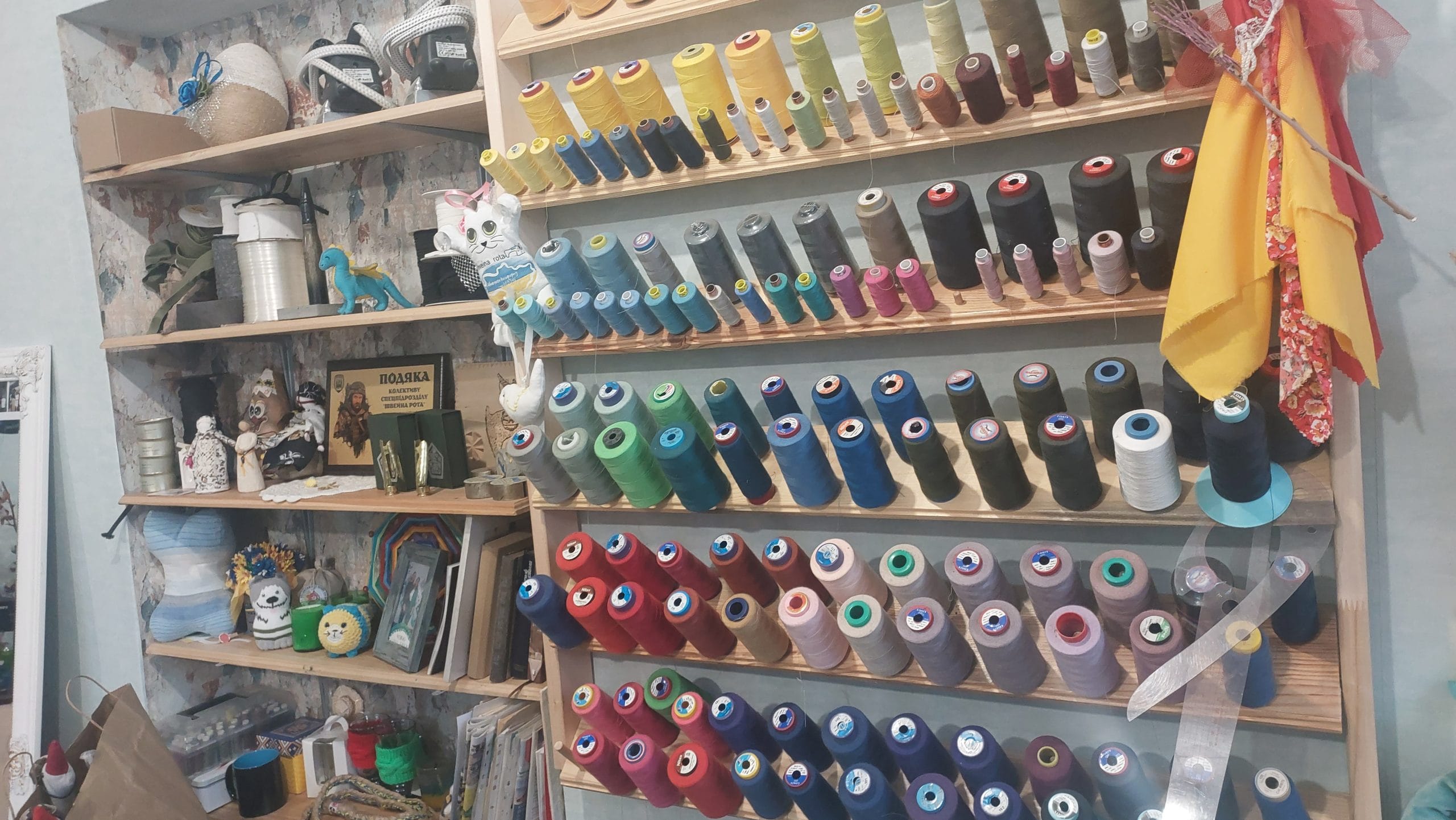
In the early days of Russia’s full-scale invasion, as confusion and fear gripped the minds of millions of Ukrainians, a remarkable initiative emerged in Dnipro. The Sewing Squad project started with a simple request for balaclavas. Today, it has evolved into a vast volunteer movement, comprising more than 30 units across Ukraine, Europe, and North America. Members of this network have already sewn over 100,000 pieces of adaptive clothing for wounded soldiers.
They brought satin and chiffon, but we needed warm khaki fleece
Kseniia Samoilych is a geological engineer by profession. She completed a sewing course, where she met financier Marina Palchenko. The two women enjoyed sewing clothes for themselves and their families, unaware that these skills would later serve a completely different purpose.

“When the war started, I immediately decided I would not leave Dnipro,” recalls Kseniia Samoilych. “It felt unbearable to just stay at my house and follow the news.”
On February 27, 2022, Marina wrote in the chat room of their sewing course, “We need to sew balaclavas for the guys from Dnipro’s local terrotorial defense.” The response was immediate.
“We grabbed our sewing machines and fabric and got to work. Some brought pink fabric, others brought white; we had chiffon and satin. But it turned out we needed warm fleece and khaki. The fabric shops were closed, and many people were leaving the city. Women were still sitting on their suitcases, contemplating whether to go or stay. The next day, we brought our sewing machines and overlockers to a regular office of a Dnipro IT company and launched the Sewing Squad to create balaclavas. We found templates online, and volunteers distributed the finished items to our defenders for free.
In our first month, the fabric was purchased by the IT people who provided us with the workspace. Our record was 498 balaclavas in one day, and we accomplished this using ordinary home machines! By April 2022, we had become self-sufficient, with fabrics sent to us by subscribers from Dnipro and other cities. At that time, we had no idea whether we could collect donations or whether anyone would support us at all.”
An IT company helped create the website
The initiative grew rapidly, and soon the women began sewing underwear, both regular and thermal. Without patterns to follow, they created the garments as best they could. One of the sewing shops had patterns for thermal underwear, and a teacher from a sewing course provided templates for general underwear. However, much of the work required them to invent their own designs. They discovered that while many templates for women’s clothing were available online, finding patterns for men’s clothing was a significant challenge.
Sewing machines were gathered gradually; as the saying goes, “little by little, a little becomes a lot.” Many machines were donated by those who had left the country, or contributed by local entrepreneurs. By now, some of the women have replaced their sewing machines for the fourth or fifth time. When machines break down, the sewing masters often remark, “What do you expect? You can work 12 hours a day, but the machine can’t, due to wear and tear.”
The Sewing Squad began attracting dressmakers from other cities in Ukraine. Initially, successful samples were redrawn and sent via Nova Post. This became costly, and they eventually, they realized it would be more practical to digitize the templates and send them in PDF format, which is convenient for printing on home printers. When there were more than two or three volunteer dressmakers in a city, they would collaborate and seek out workspace, collecting donations to purchase fabric. Storing all the finished garments in Dnipro was risky due to the constant threat of air raids, so they decided it was better to send as soon as orders were completed.
To facilitate this, the Sewing Squad’s website features a Google form that allows soldiers, the wounded, and their families to place orders. The site, developed by the IT company SoftServe in collaboration with students from the National Technical University of Ukraine ‘Dnipro Polytechnic’ as part of the SoftServe Academy hackathon, also offers patterns, detailed workshops, and video tutorials for those who want to get involved in the project. Additionally, there is a link to a donation jar. All the craftswomen sew the clothes for free.

Adaptive clothing is in great demand in all areas
Over time, the Sewing Squad expanded the range of items they produced, recognizing a significant demand for clothing for wounded defenders, often referred to as “cyberwear” by the seamstresses. Their first request came from the Dnipro hospital, which asked for underwear with drawstrings. The dressmakers used fabric donated by local residents of Dnipro to fulfill this request.
Maryna volunteered at the Dnipro hospital from 2014 to 2015, where she adapted clothing for defenders. Following a contribution of UAH 5,000 from a subscriber of Sewing Squad’s social media, Iryna Bogdanova, the craftswomen had enough funds to bulk-purchase fabric for sewing. Marina and Ksenia realised they could develop collections and initiated their first large, joint purchase of 200 meters of fabric. Following this, they continued to expand. The “Share the Warmth” fundraiser has been ongoing for three years. Adaptive clothing is unique and highly variable, as the designs depend on the specific nature of each injury. The volunteers faced many challenges but eventually gained experience to create the most comfortable models to meet the various needs of the wounded.
“For example, let’s take adaptive socks,” Kseniia explains. “If a wounded person has a long external fixation device on their leg, the sock size will be different than for someone with the device only on the lower part of the leg. These socks feature buttons that unfasten in the center, and they come with various fasteners because everyone is fitted with devices differently. We strive to adapt to each request as much as possible.” The craftswomen in the Mr. Socks department specialize in knitting adaptive socks.
As time went on, seamstresses developed dozens of clothing models for individuals with devices on their arms and legs. Wounded fighters receive adaptive T-shirts and sweatshirts with hook-and-loop fasteners or buttons for arm injuries. Those with leg injuries are provided with adaptive underwear, shorts, trousers, and socks. Additionally, they receive a shoulder bag for personal belongings and a pillow to help them sleep comfortably.

A notable innovation is the adaptive hoodie, which can be seen on a mannequin named Orest, a gift from the military to the craftswomen. “We were sewing in a very cold room, and I had hardly any warm clothing,” Kseniia Samoilych recalls. “Before the war, I worked in a warm office, but now I was in a freezing environment, and we started getting sick. Then I thought, ‘I need to sew myself a hoodie.’ I made one and realised that the guys at the front line, including the wounded, also needed one. It’s a very warm and comfortable garment, with a hood that can replace a hat in case of a head injury. We already had patterns for a cyber jacket, so we only needed to figure out how the cyber hoodie should zip up. Now we sew hoodies, and they have become very popular orders from September to May.”
Currently, the Sewing Squad produces clothing in three sizes: S, L, and XL. They cater to requests for individuals with complex devices, amputations, and even for wedding or holiday attire.
Additionally, it’s common for seamstresses to assist the same wounded soldiers over several years. As the soldiers transition through various hospitals, their health conditions and needs change, and they communicate these changes to the seamstresses, who adapt accordingly.
It is common for soldiers’ clothing to become burned in combat on the frontline and they cannot simply visit a store for replacements. Often, they don’t inform their families about this. Recently, burn unit patients receiving treatment requested standard military clothing to wear outside. The Sewing Squad from Nikopol has now specialized in creating military attire, including uniforms, ubaks (special tactical shirts), and thermal underwear for male and female defenders.
Beyond addressing individual requests, the craftswomen collaborate with volunteers and medical professionals at over 90 stabilisation centres, hospitals, and clinics throughout Ukraine and internationally. This includes rehabilitation centers in Sweden and Germany where Ukrainian soldiers are treated. When volunteers from a specific hospital prepare to meet an evacuation train or bus with many wounded individuals, they fill out a Google form detailing the approximate number and type of clothing needed. The Sewing Squad units coordinate with each other to provide custom-made clothing items, which volunteers then distribute to the military.
Over time, the Sewing Squad began creating adaptive clothing not only for men and women but also for children, who, although not on the battlefield, often require such clothing.
The first young client was an injured eight-year-old boy who had been hit by a car. He spent a year using a special apparatus, which made it impossible for him to wear regular clothes. His mother, Lesya, expressed her gratitude by drawing a postcard. Gradually, the sending of postcards between the craftswomen became a cherished tradition, and it continues to this day.

All hope is in the volunteers
Today, more than 800 craftswomen from all over the world are part of the Sewing Squad. This initiative operates in various subdivisions located in Dnipro, Kyiv, Lviv, Zhytomyr, Kharkiv, Poltava, Ternopil, Bobrynka, Nikopol, Vinnytsia, Odesa, Remeniv, Lutsk, Rivne, and Slobozhanske, as well as in Canada (Toronto and Vancouver), Germany, Denmark, Poland, the UK, and other countries. The fabric for the volunteers in Ukraine is acquired through donations to the ‘Share the Warmth’ fundraising campaign (Sewing Squad bank) and independent collections by the subdivisions, which are then sent to various Ukrainian cities.
Abroad, dressmakers typically purchase fabric themselves by organising personal fundraisers or charity events, except in Switzerland, where fabric is very expensive. In that case, they receive pre-cut fabric from Ukraine. Additionally, it’s essential to find a suitable location to cut large rolls of fabric and have a cutting knife readily available.

Initially, the women in Dnipro did not have a cutting knife; they cut thick fabric with ordinary scissors, sometimes resulting in injuries to their fingers. Kseniia and Marina had to wait for their fingers to heal before they could continue their work. This difficulty persisted until Maryna’s husband gifted her a cutting knife for her birthday, making the fabric cutting process significantly easier.
In addition to clothing, the dressmakers sew hats, evacuation blankets, bags for personal documents and belongings, comfortable waterproof underpads, pillows, pain-relieving rollers, and more. Each product includes a special label with its name, size, and a QR code that can be scanned to order additional items free of charge. Many members of the Sewing Squad not only sew clothes but also visit wounded soldiers in hospitals. They provide hygiene products and treats, assist with renewing documents, SIM cards, and bank cards, and offer emotional support by simply talking with the patients.
“Very often, volunteers tell us that the moment the soldiers see the underwear we have sewn, they smile for the first time after being wounded,” says Ksenia Samoylich. “They frequently ask us to continue making colorful underpants. Once the wounds heal or prosthetics are fitted, they want to wear normal clothes. They don’t want to stand out when they go shopping or to cafes, avoiding condolences. That’s why we strive to ensure that adaptive trousers or blouses look like regular clothing.”
The demand for clothing for military personnel undergoing treatment and rehabilitation across Ukraine remains enormous. Recently, the Dnipro seamstresses met with the State Defence Procurement Agency. They are focusing exclusively on sewing adaptive clothing and have already produced T-shirts, sweatshirts, shorts, and trousers for the cold season. However, there is still a lack of warm sweaters, underwear, women’s clothing, and socks suitable for those who have been injured. Hence, all hope lies with volunteers who dedicate their time and resources to this important cause. Many coordinators of this initiative have left their main jobs to work on the Sewing Squad full-time, a sacrifice made possible by the support of their families, who take care of their financial needs. Volunteer seamstresses sew adaptive clothing in their free time, balancing it with their primary jobs and household responsibilities.
“Unlike the government, we have learned to respond quickly to various requests,” Ksenia concludes. “For example, women from Nikopol, which is constantly under enemy fire, sewed wedding trousers from Italian wool for a wounded soldier named Oleksiy. The trousers were very beautiful. Oleksiy had undergone an amputation of one leg and had an external fixation device on the other, making the task quite challenging. Nonetheless, the trousers turned out great. Oleksiy got married and subsequently continued his treatment.

Nevertheless, government support is still crucial at all stages of evacuation, treatment, and rehabilitation for the wounded.”
According to the Sewing Squad’s website, its members have sewn over 100,000 garments. However, Kseniia Samoilych claims that the actual number is three to four times higher. One dedicated craftswoman can sew about a thousand items in a year. It is worth noting that not all dressmakers are comfortable sewing for the wounded, as it can be a psychological challenge for some. However, in addition to adaptive clothing, the craftswomen receive many other requests, such as making pillows or bags, allowing anyone to participate.
British volunteer
David Michael Chatterton is a volunteer in the Sewing Squad. He is a qualified electrical engineer living in Winchester, in southern England. While he is not a professional tailor, he has always been interested in the mechanics of sewing machines.

David owns a Singer foot-operated sewing machine that once belonged to his great-great-grandmother, who used it to sew after her husband returned wounded from the First World War. She took up sewing to support their family.
David has taken various courses at a local adult education division of a sixth-form college, including several on sewing. It was during one of these courses that he met Olha Kott, a Ukrainian woman who has lived in the UK for 18 years. Olga was looking for volunteers to help sew adaptive clothing, and David immediately decided to lend his support. He feels he has been fighting alongside Ukrainians for two and a half years through his work with a sewing machine. In addition to sewing, he wears an embroidered shirt, plays the flute, and enjoys traditional Ukrainian dishes like varenyky and borscht, which he has even started to cook himself.
Ukrainian volunteers in England are planning to collaborate with an Afghan sewing club to produce adaptive clothing, and David will provide training for the tailors involved.
“Since I have an overlocker, I am comfortable sewing the inner seams of clothing,” says David Chatterton. “I have upgraded to a model with automatic threading and have also purchased a much better Juki sewing machine, which allows me to sew quickly and efficiently. I can easily make four pairs of trousers in a day. After sewing, I hand them over to Olha Kott, who sends them to where they are most needed in Ukraine. I admire the courage of Ukrainians who are resisting Russian aggression — without it, Russia would already be trying to invade the Western world. To the men and women of Ukraine, I want to say how much I admire your bravery, and I am confident that you will prevail. It is a great honor for me to do something for our wounded heroes, and I sincerely wish them a speedy recovery.”

Author: Yulianna Kokoshko
Ukrainian language editor: Anastasia Zanuzdanova
English language editor: Helen Lewis
Photos by the author, from the Sewing Company archive and the heroes of the publication.