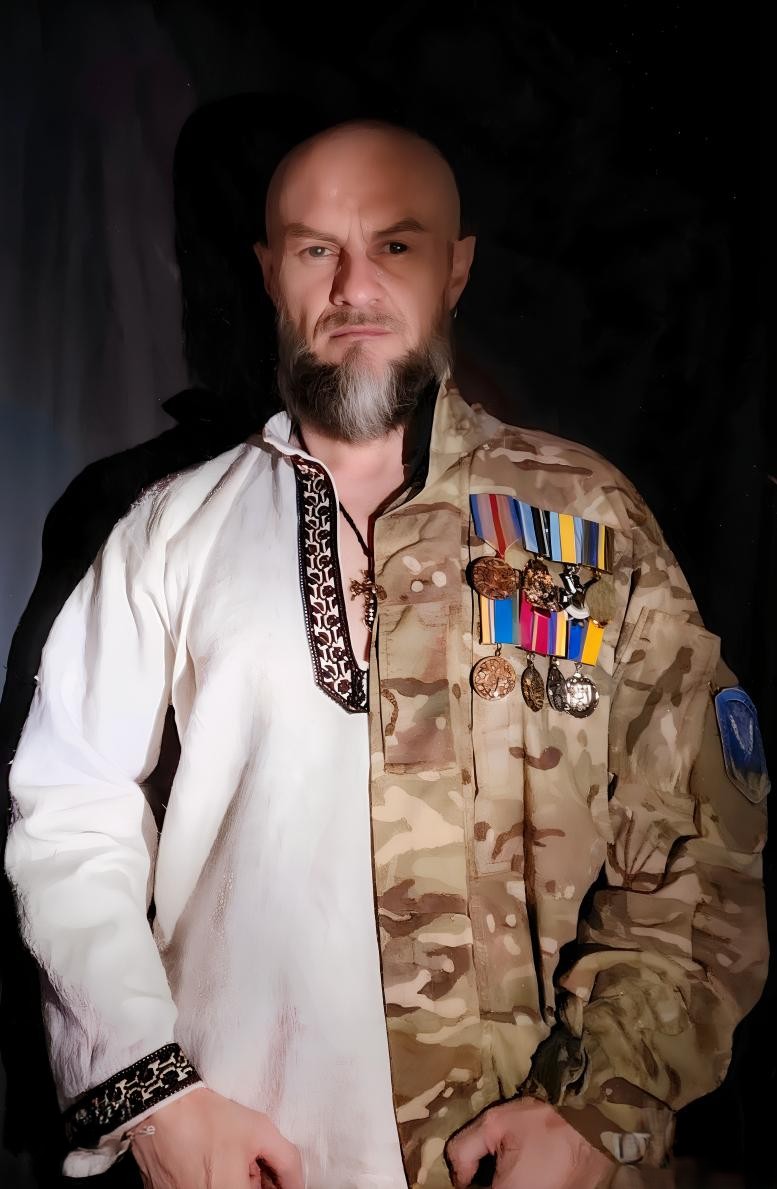
“There were times when we had to sit in the snow for several days, and then literally dig ourselves out. Now I have two prosthetic legs.”
Today, Roman, together with his wife, is actively developing their own craft business. He is an Honoured Folk Master of Ukraine and inspires others to bring their dreams and passions into life.
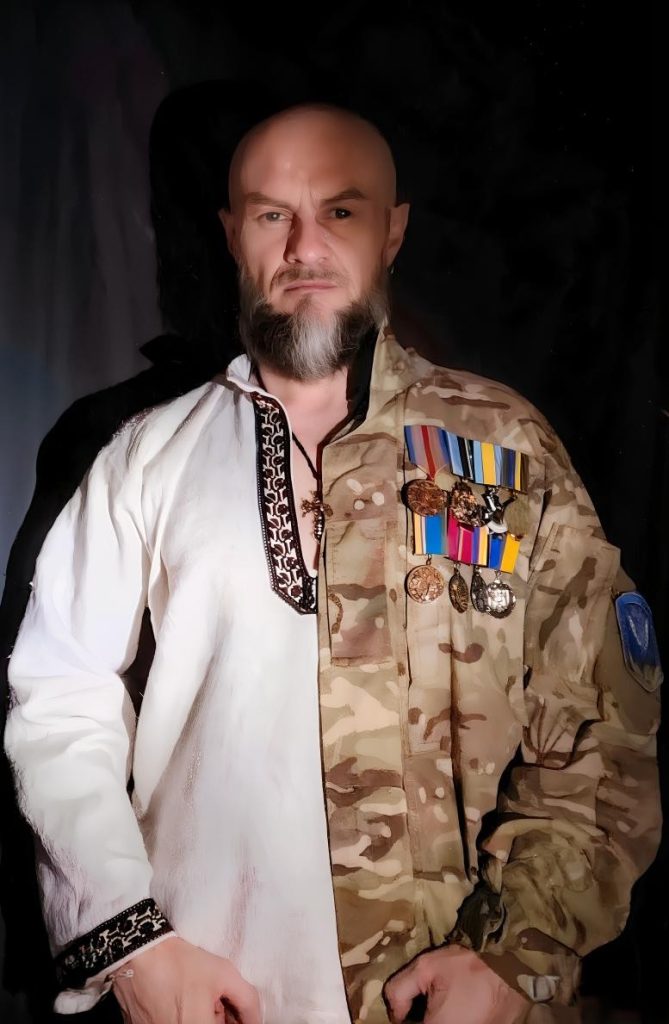
How a veteran came to love embroidery
“I started embroidering thanks to my second wife. We had known each other since school. Then, years later, we met again — and although she didn’t recognise me straight away, we started seeing each other.
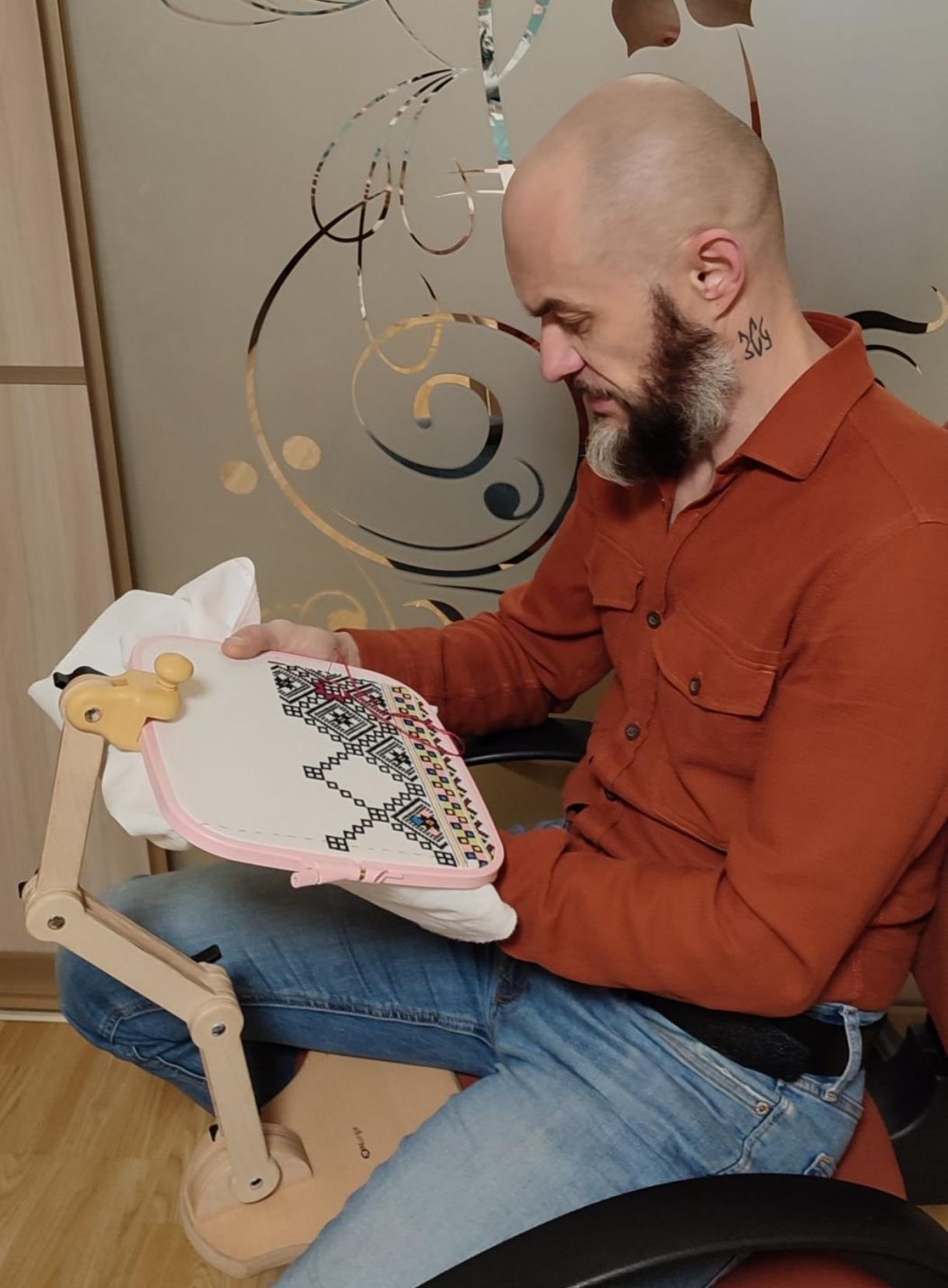
I knew nothing about embroidery before,” Roman Didera says. “I could sew a button on in the army — that was about it. When my wife and I got married, she worked in a craft shop and loved embroidery herself, using seed beads. In the evenings, I would sit and watch her, see how much she enjoyed it and how impossible it was to pull her away from it. So I said, ‘Go on, I’ll give it a try.’
Naturally, my wife reacted sceptically, but straight away, half-jokingly, I said, ‘You’ll see — I’ll manage it, and one day I’ll even embroider a shirt for you.’ I knew nothing about colour numbers, types of stitches or patterns — she simply poured me a handful of seed beads, and I sat beside her and started embroidering.
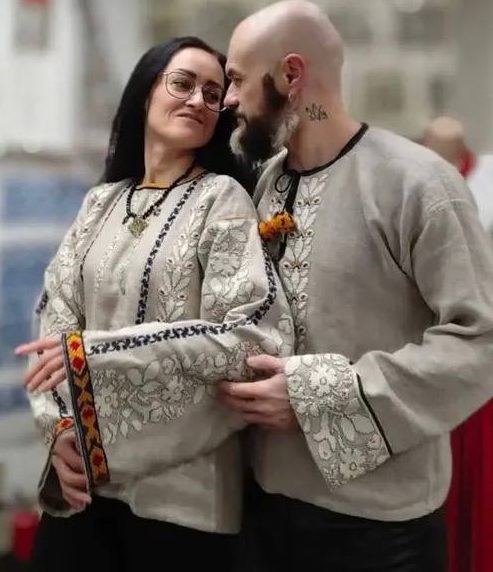
We talked about everything — suddenly, we had new shared topics. Later, I also started working in the craft shop and began looking for more complex work. The first piece was a portrait of Jesus, 50 by 50 centimetres. I had to travel all over the city to find the right colours, but after three or four months, I finished it.
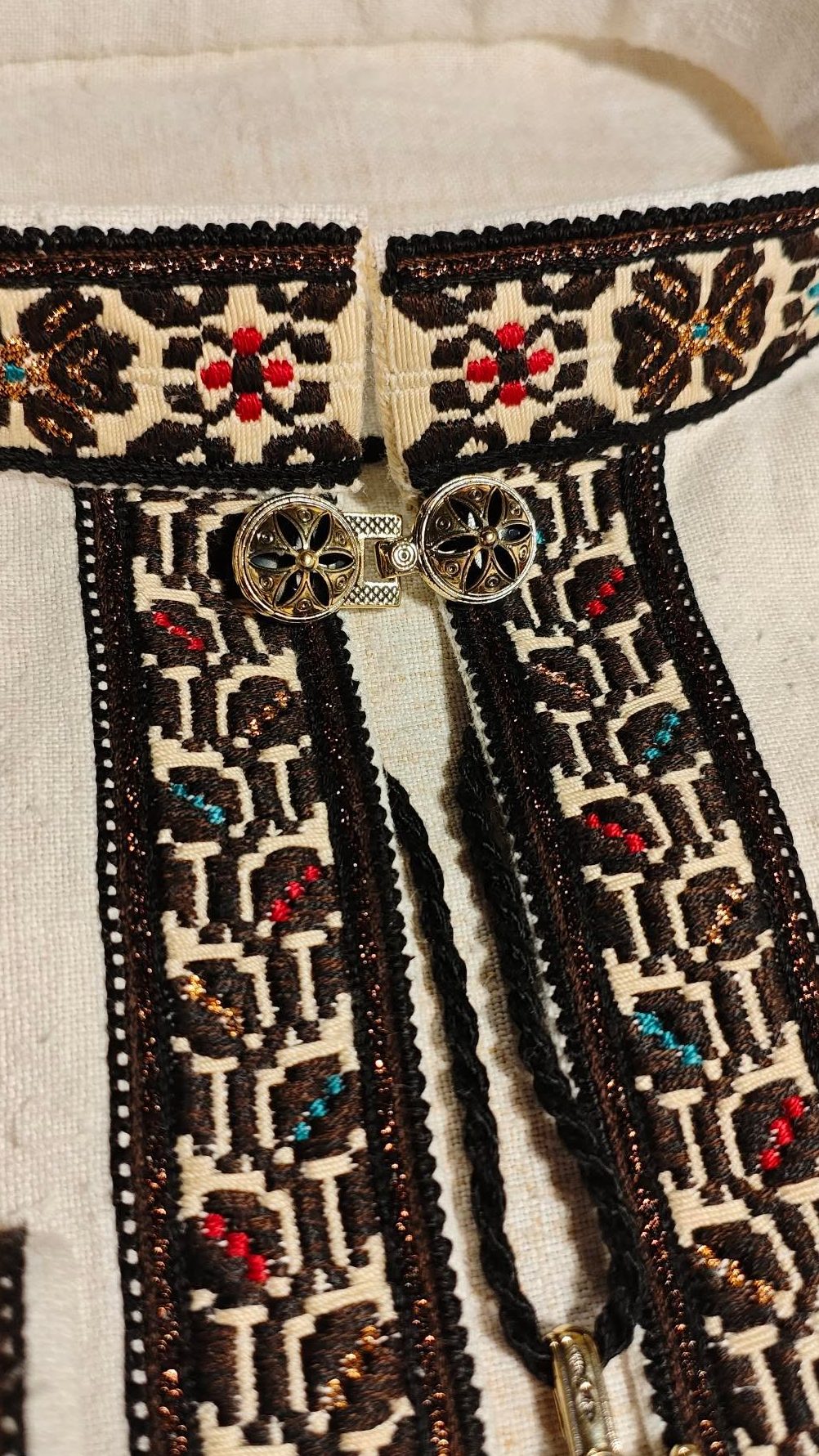
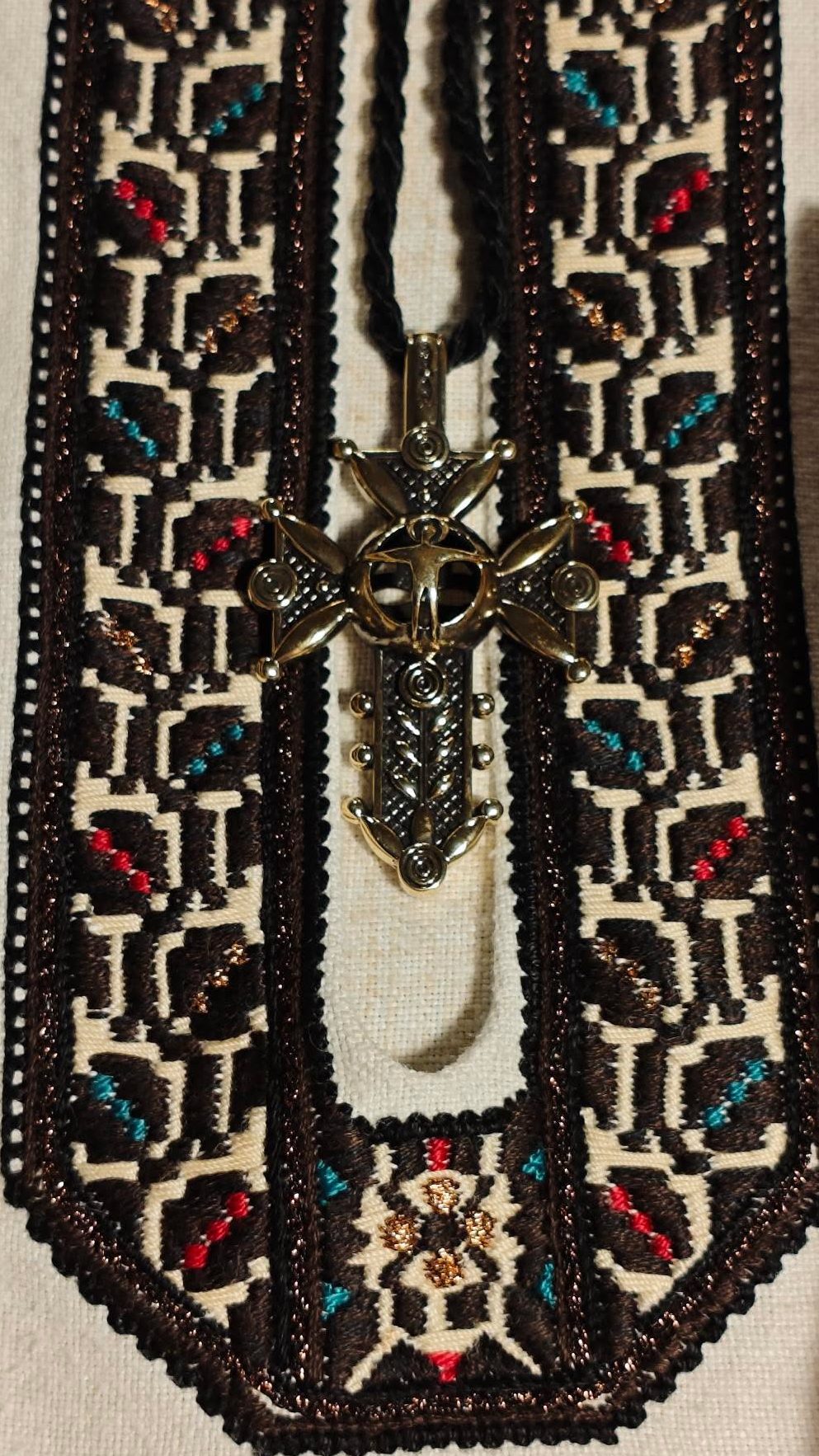
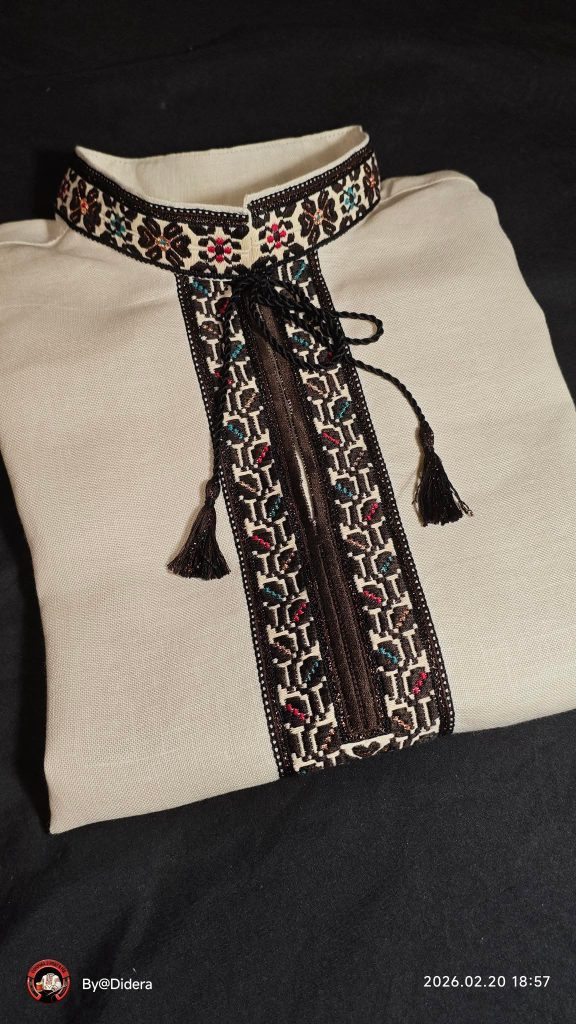
I asked my wife to embroider a shirt for me. Before that, she had rarely worked with thread, but she took it on and made it. That shirt is the most precious one for me — the first in my life. After that, I embroidered one for myself and started making shirts for my wife, too.
I’m a very restless person — I don’t like monotony. The patterns I worked with had to be reproduced exactly. That felt too repetitive — I wanted to change something.
In the craft shop where we worked, I met Yurii Melnyk and Ania Rohatynska — they study embroidery and historical stitches. I watched one of Ania Rohatynska’s masterclasses and felt deeply inspired. I created my first piece on an old antique fabric gifted to me by Yurii Melnychuk. Now I look at it and understand that it isn’t perfect, not everything is as neat as I would like — but it was my first work of that kind.”
Every shirt is unique — no repeats
Today, people often tell me that even if I presented my work under a different name, they would still recognise it — that I have my own style. Perhaps that is because I don’t want to work in a formulaic way — every shirt has to be different and more complex. I don’t have two identical shirts.
Even when I use an embroidery pattern as a base, the result comes out completely different — something truly mine.
I know about 40 of the 200 stitches, and still I don’t have two identical shirts: each one is unique, yet recognisable.
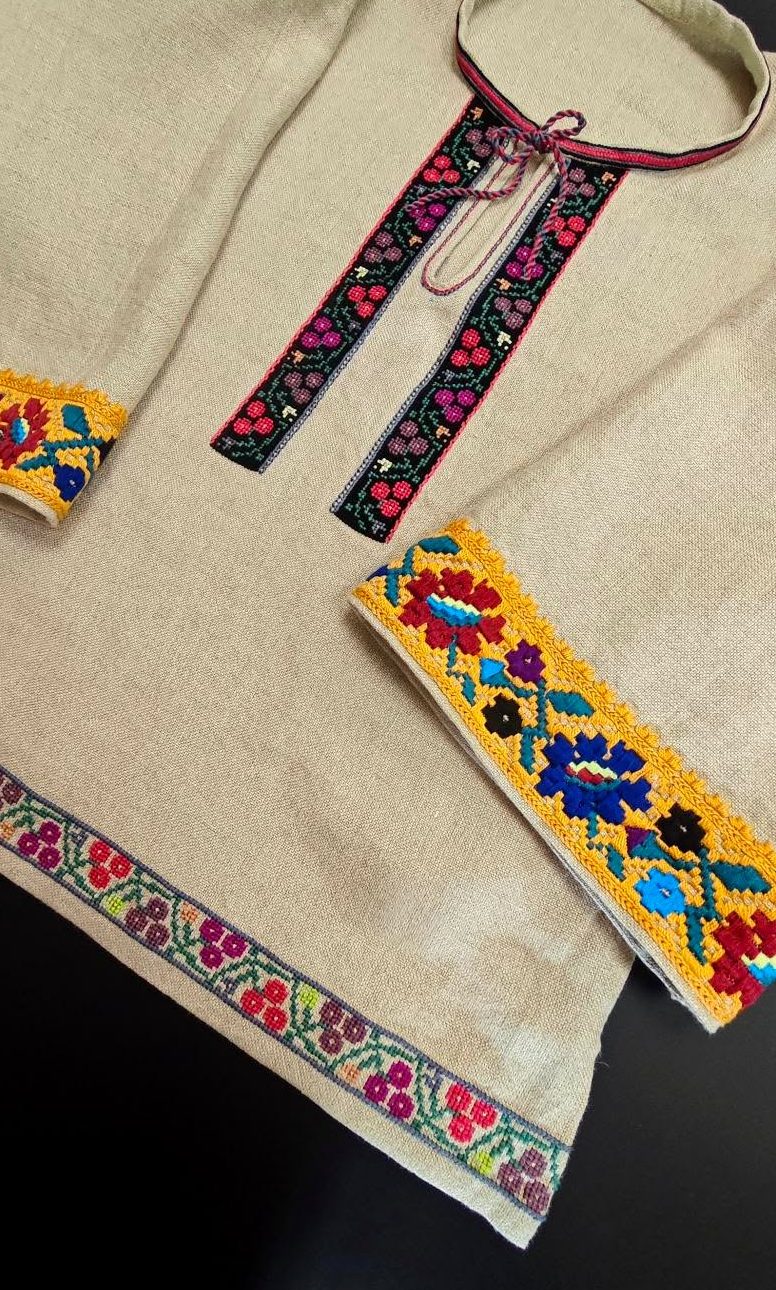
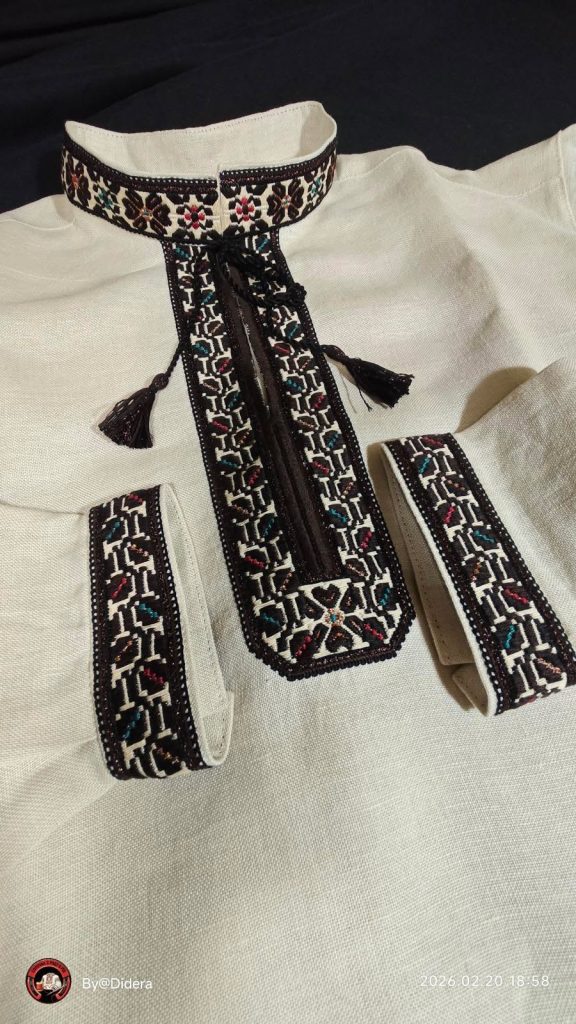
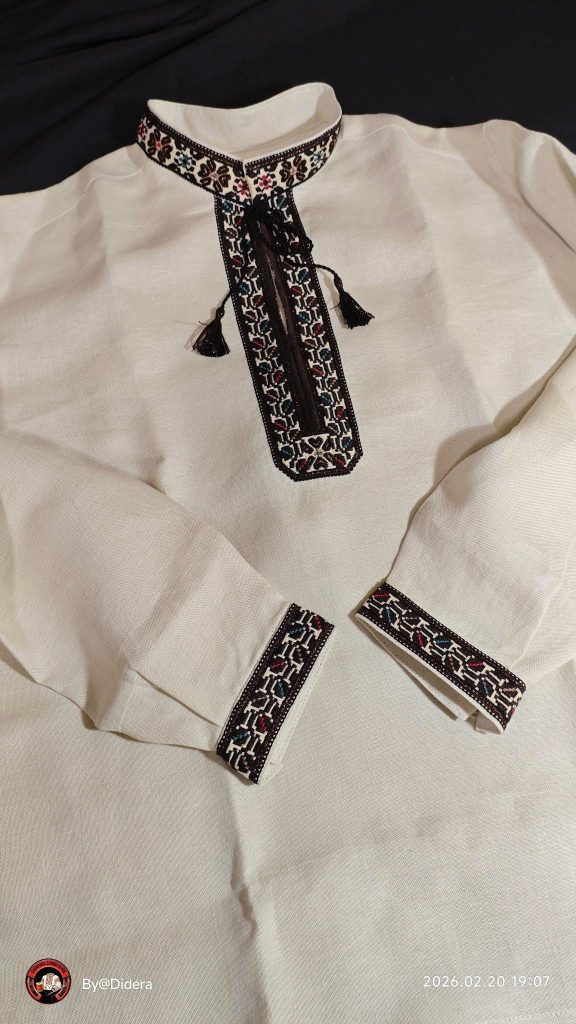
I don’t like monotonous stitching. Although a shirt made with just one technique can still be beautiful, it needs careful planning. At the moment, I use at least five to seven stitches in one piece. You really need to understand this: not every stitch works with another. Colours also combine differently depending on the stitches.
Our ancestors were extraordinary people — it must be a whole science to explain how everything is combined in a vyshyvanka. Every time I see it, I’m amazed.
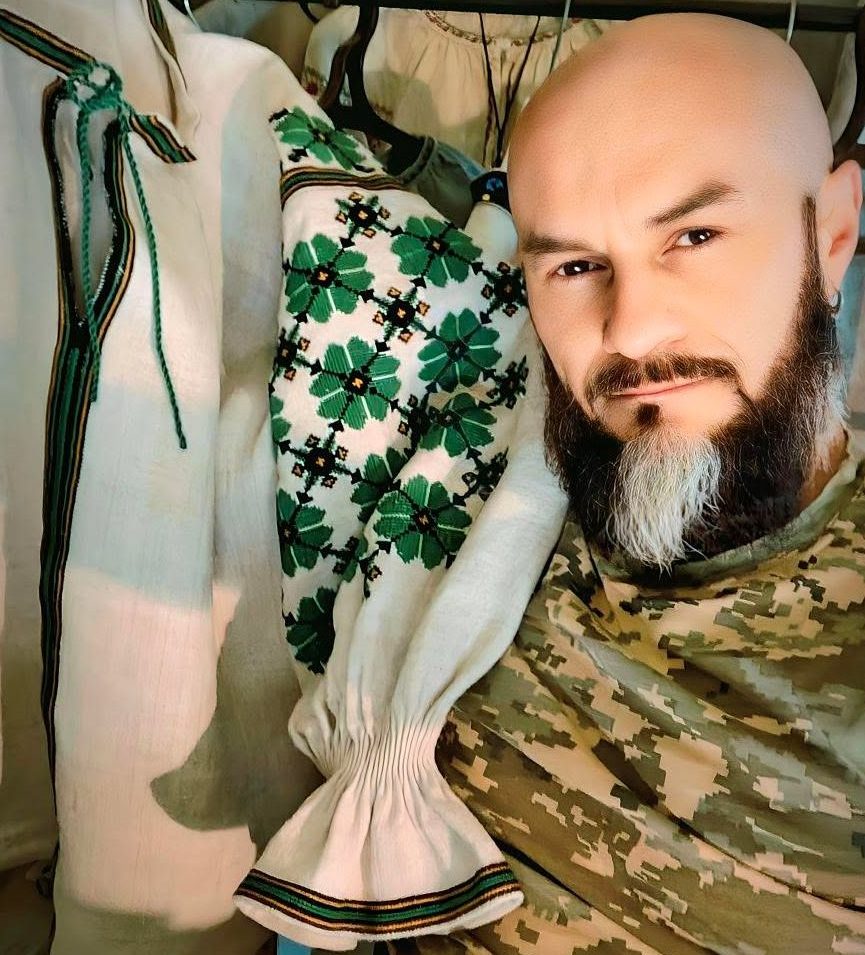
There is a book on embroidery by the Pokusinsky family, “Borshchiv Traditional Shirt: Field Research Materials and Private Collections,” by my friends, Liudmyla Pokusinska and Oleksii Pokusinskyi. It is impossible to buy now. It’s 500 pages long — very rare and very expensive. I would love to have it, but it’s like a treasure — impossible to get hold of.
I have a few photographs from this book, but even when I take something from it, I still build one design out of three or four embroidery patterns. Even if someone has seen one of our shirts and wants to order it, I don’t make an exact copy — not even when things are financially difficult, and I need the work.
We have this as a rule: we can embroider something similar, select something, and agree on it with the client, but there will be no repeats.
I keep one sample for myself, while the person receives a unique piece and feels special. It’s the same as when my wife embroidered a shirt for me: she took a popular embroidery pattern, but interpreted it in her own way and chose different colours. I am the only one who has that shirt. We try to do the same for others.
Sometimes people order shirts from a particular region. For example, there was a couple who wanted a shirt for a man from one of Ukraine’s regions, Zakarpattia, and one for a woman from Melitopol. Although I change every pattern and add something of my own, in cases like that, authenticity has to be preserved.
Contemporary and traditional embroidery “passed down through generations”
Now I embroider a lot, and quite quickly — around two to three weeks for one shirt. With power cuts and blackouts, we have a habit of checking whether all our devices are charged. Whether there is electricity or not, embroidery doesn’t stop. The working process has to remain steady.
So far, 40 shirts have been made; 20 of them just last year. Of course, I’m not going to wear all of them myself: I embroider one, enjoy it, try it on, take a photo — and immediately start imagining the next.
When our work in the craft shop ended, my wife wanted to look for another job, but I said, “No one is going to look for another job — we’ll build our own business.”
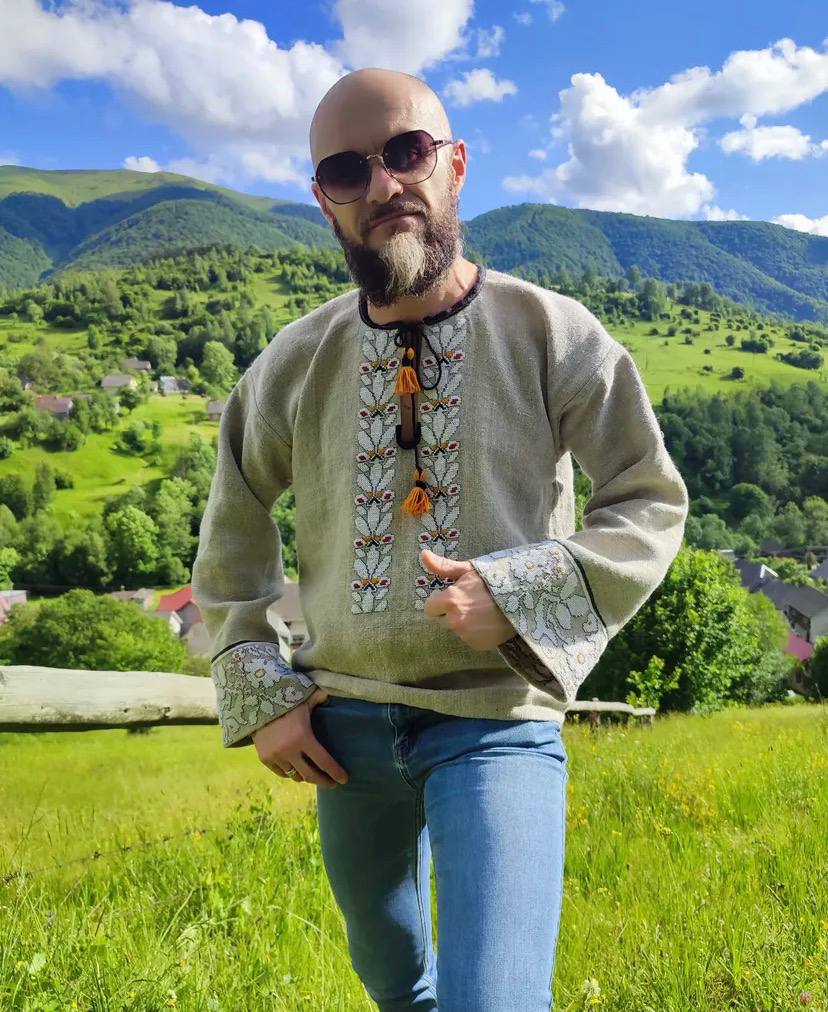
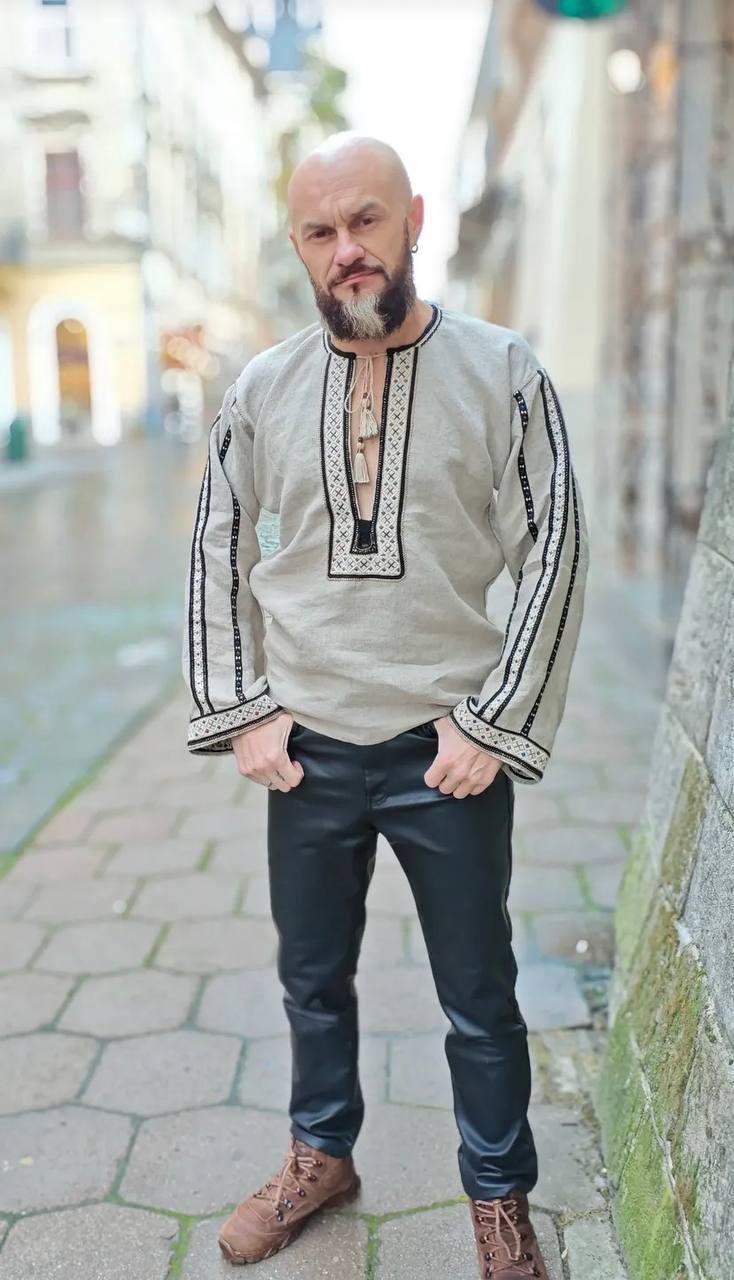
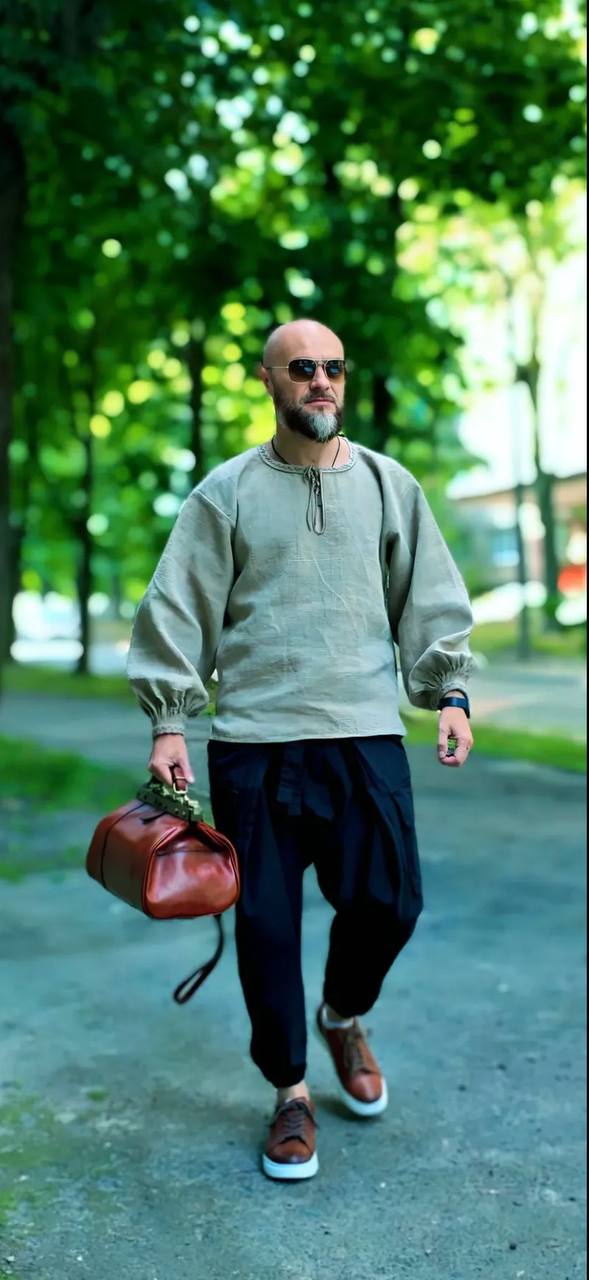
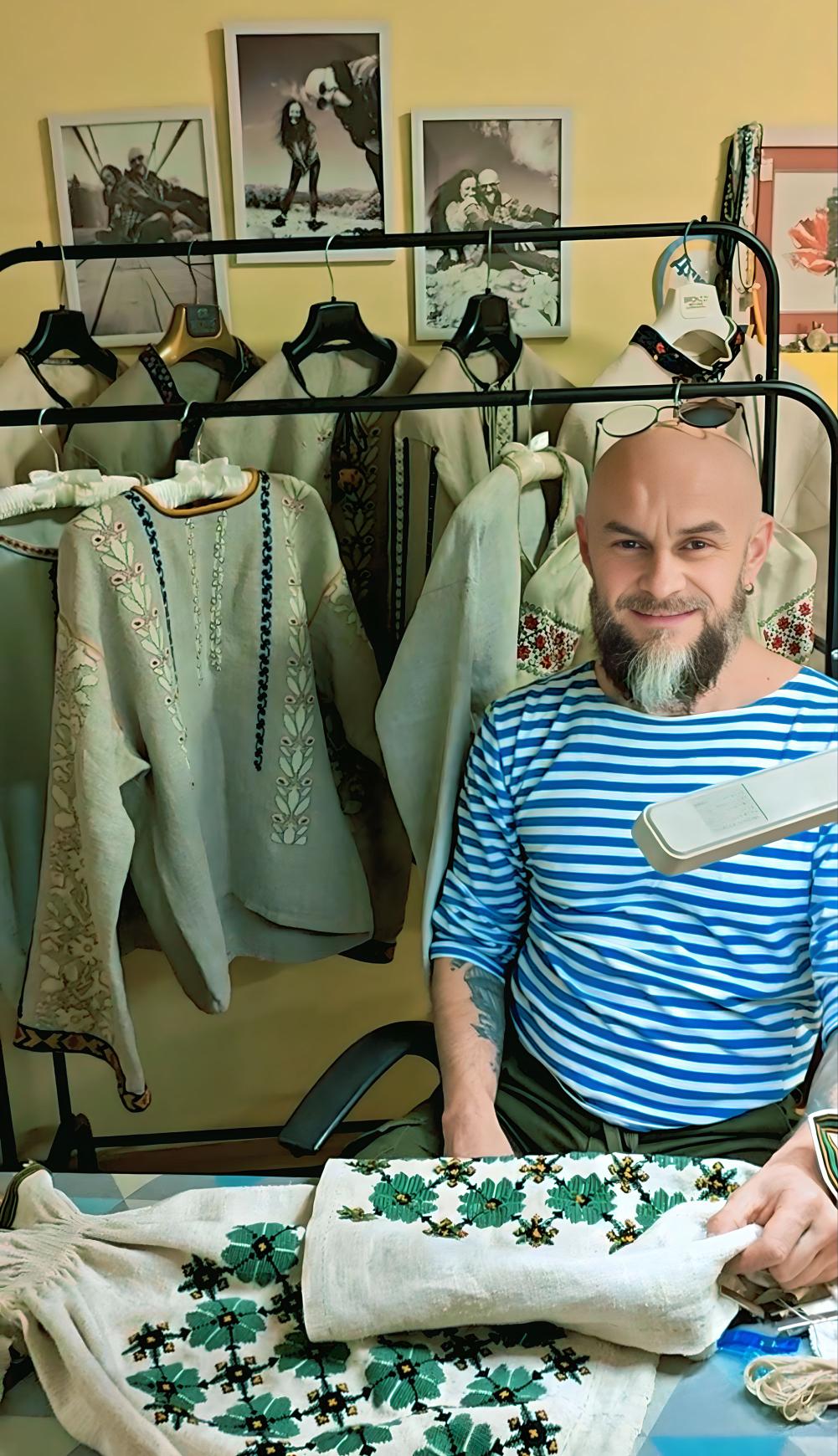
My wife prefers modern, high-quality German fabrics, while I work with old hemp or linen cloth. Each of us has our own niche.
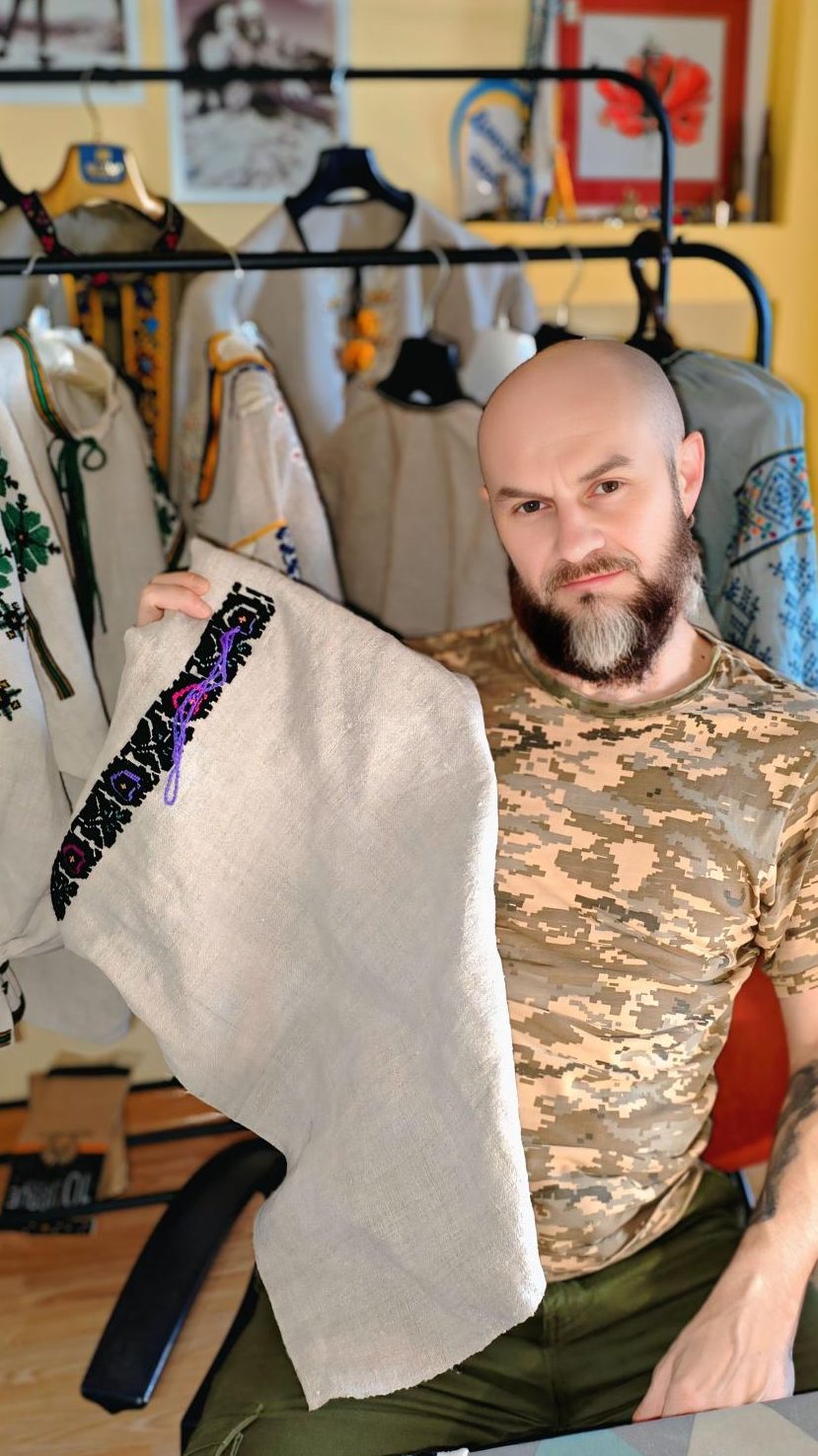
Old shirts look beautiful and are often passed down from generation to generation, from family to family. Some are already over 100 years old and will continue to be passed on. That’s why we created our page and called it “A Shirt Passed Down Through Generations.”
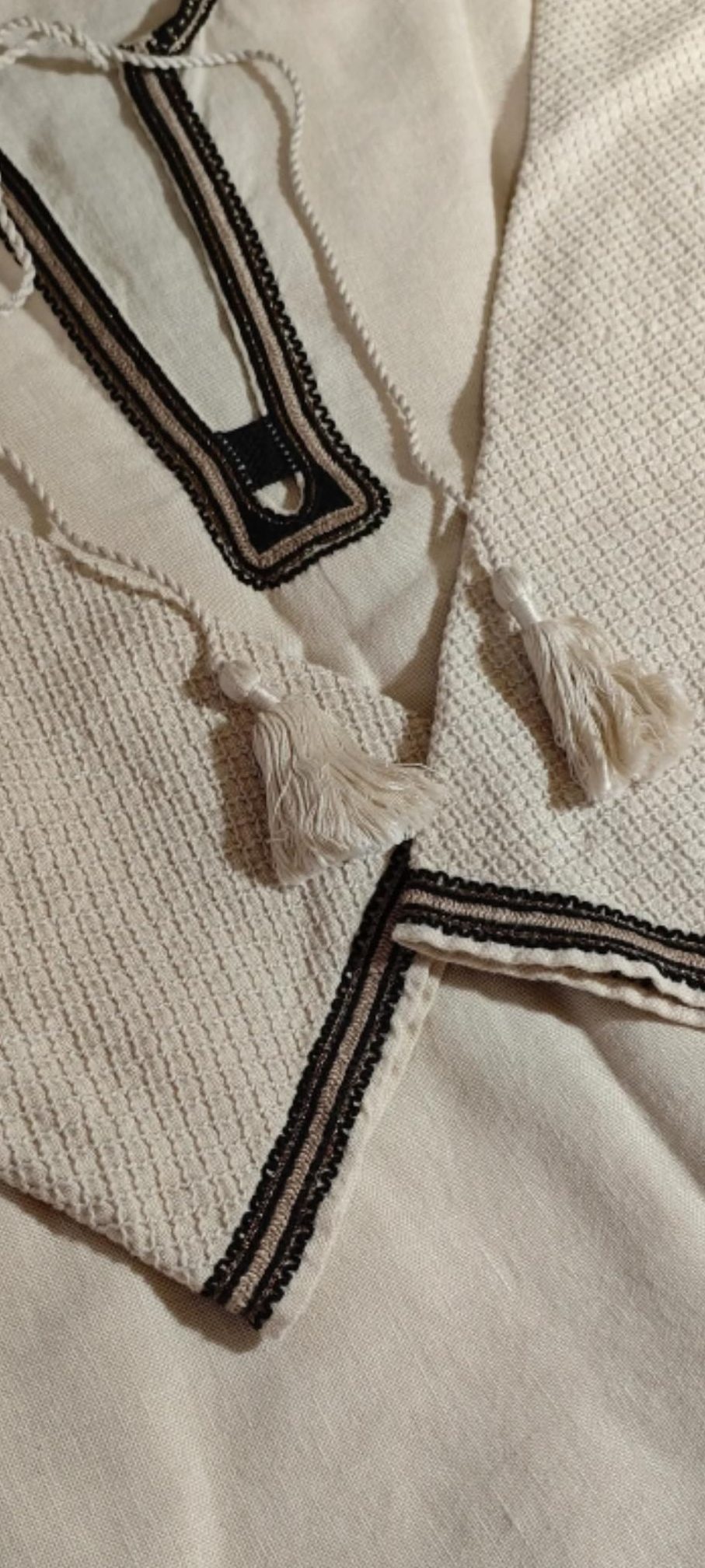
At first, selling didn’t really work out — it felt odd. But when we sold a few shirts, and I saw the joy and satisfaction on people’s faces as they tried them on, that reaction gave even more pleasure than the embroidery itself.
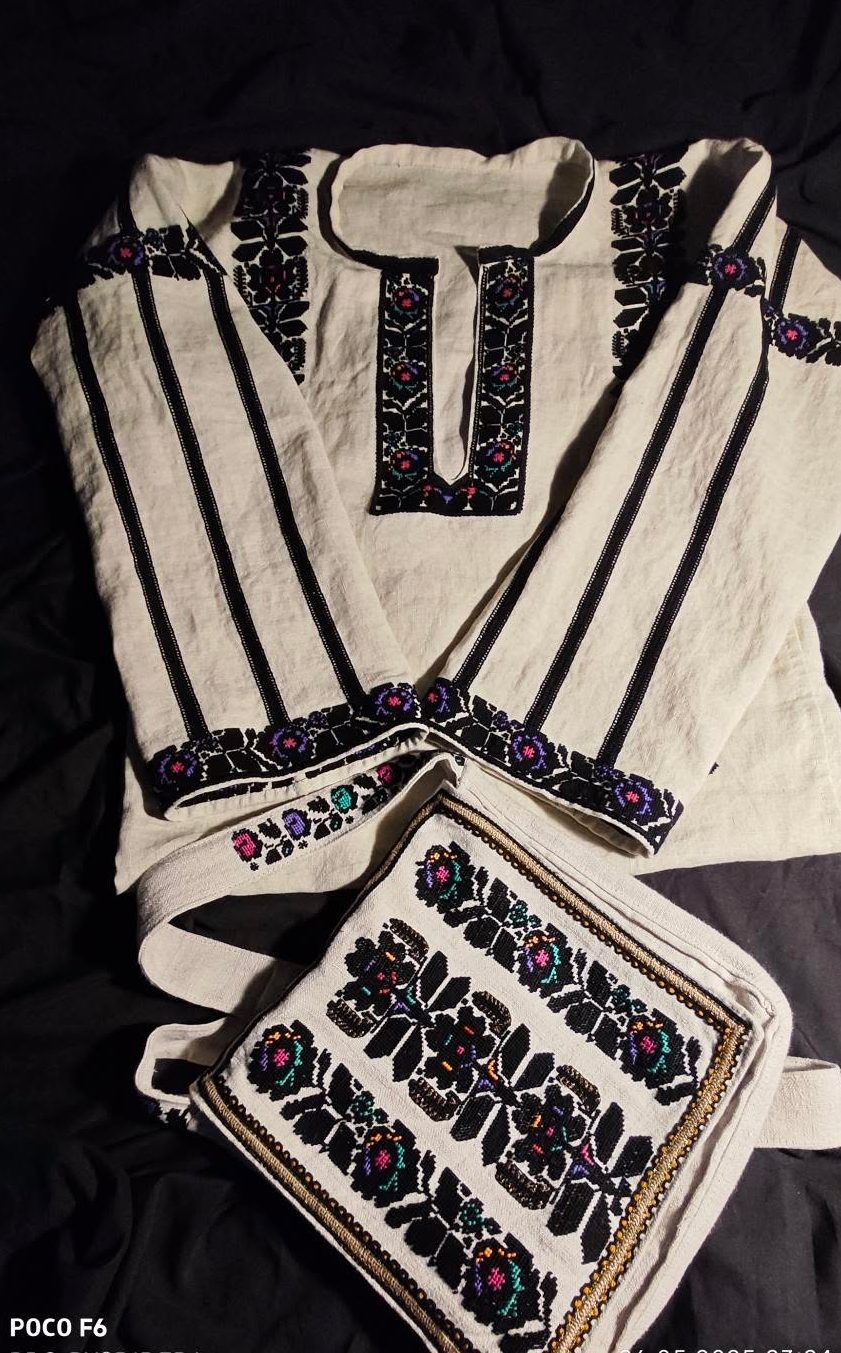
Once, Yurii Melnychuk came and showed me an old shirt, around 100 years old. He had bought it at a market in Kosiv for next to nothing. I was stunned — the level of detail, those stitches done millimetre by millimetre. Then he pulled out another shirt. It was embroidered in violet-blue tones with gold. My wife was saying something to me, he was saying something to me — but I wasn’t really there. I was inside that shirt, inside those stitches. I didn’t know what those stitches were. I said to Yurii: “I would need about four years to make this, but I want it so much.” And you know, about two months later, it came out of me. It turned out completely different: I added my own elements, some different stitches, and kept only the base. It became one of the shirts I will never sell. It’s incredibly beautiful.
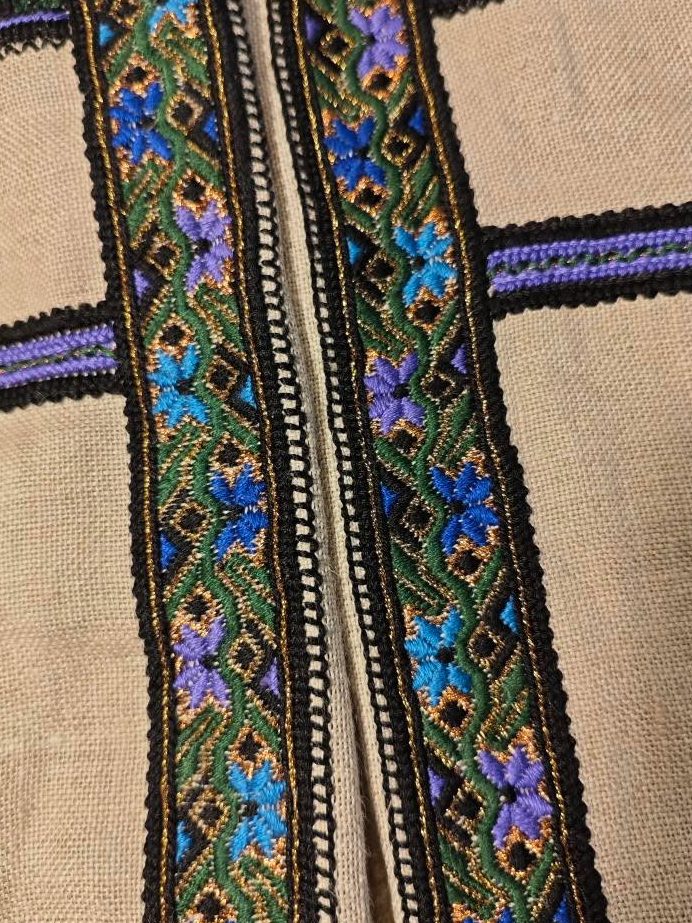
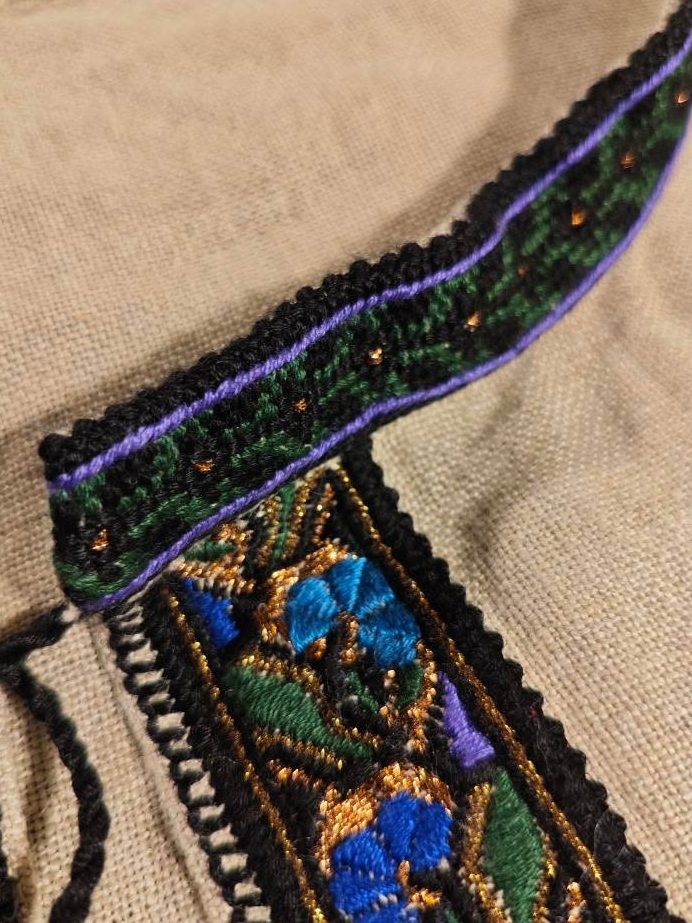
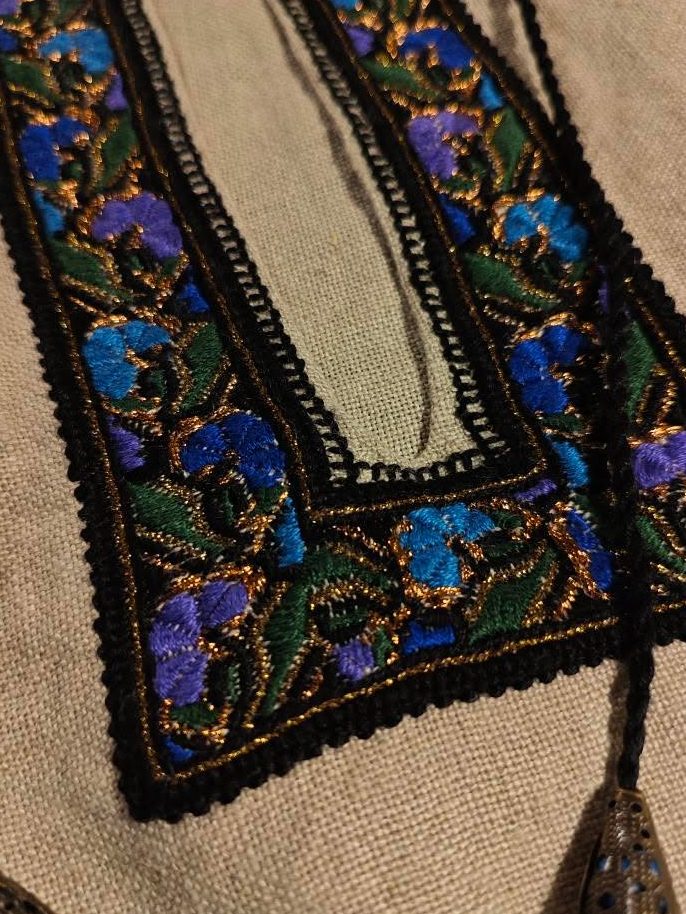
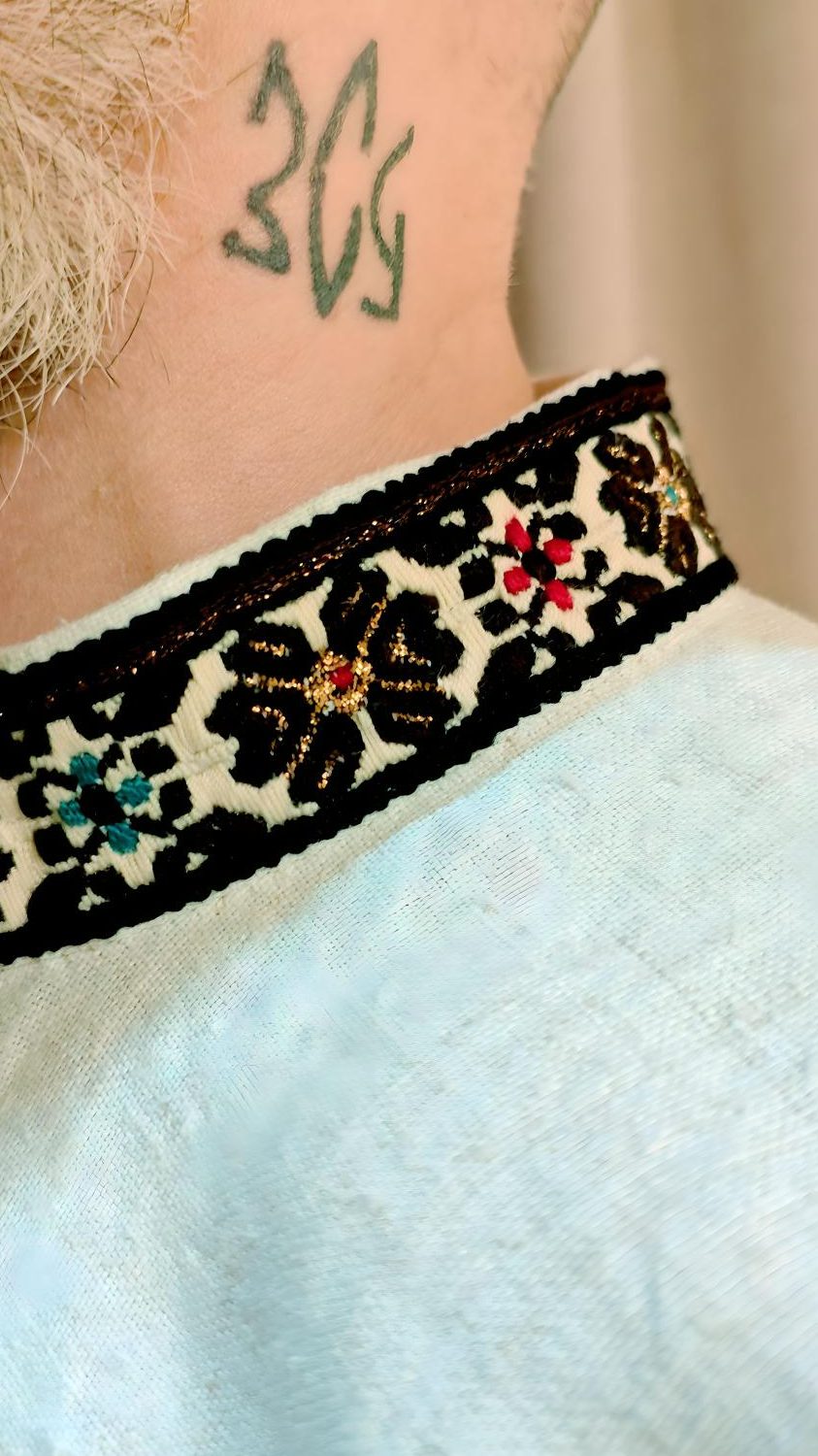
I love looking closely at embroidery. If something catches my attention, I have to go over and examine it: which region it’s from, how it was made, what stitches were used. For example, if it’s black on white fabric — that’s Borshchiv embroidery — named by the city name where it appeared first. Borshchiv embroidery is very unique and unusual because of the colours and stitches. Machine embroidery doesn’t interest me much, even though it can be beautiful, too. But when a vyshyvanka is made by hand and passed down through generations — because every triangle, every combination of crosses is a protective symbol, everything has meaning — that’s something else entirely.
Once I saw an old Borshchiv shirt that I really liked, especially the collar, and I reinterpreted it the other way round. Then I created a women’s shirt in the same style. It turned out stunning.
We don’t place our shirts in shops. Somehow, I don’t like the idea of people handling them and then someone else buying them. But, as they say, never say never. We didn’t plan to start working on commissions straight away either. At first, we worked only with standard sizes. Then people started coming, and we began taking measurements.
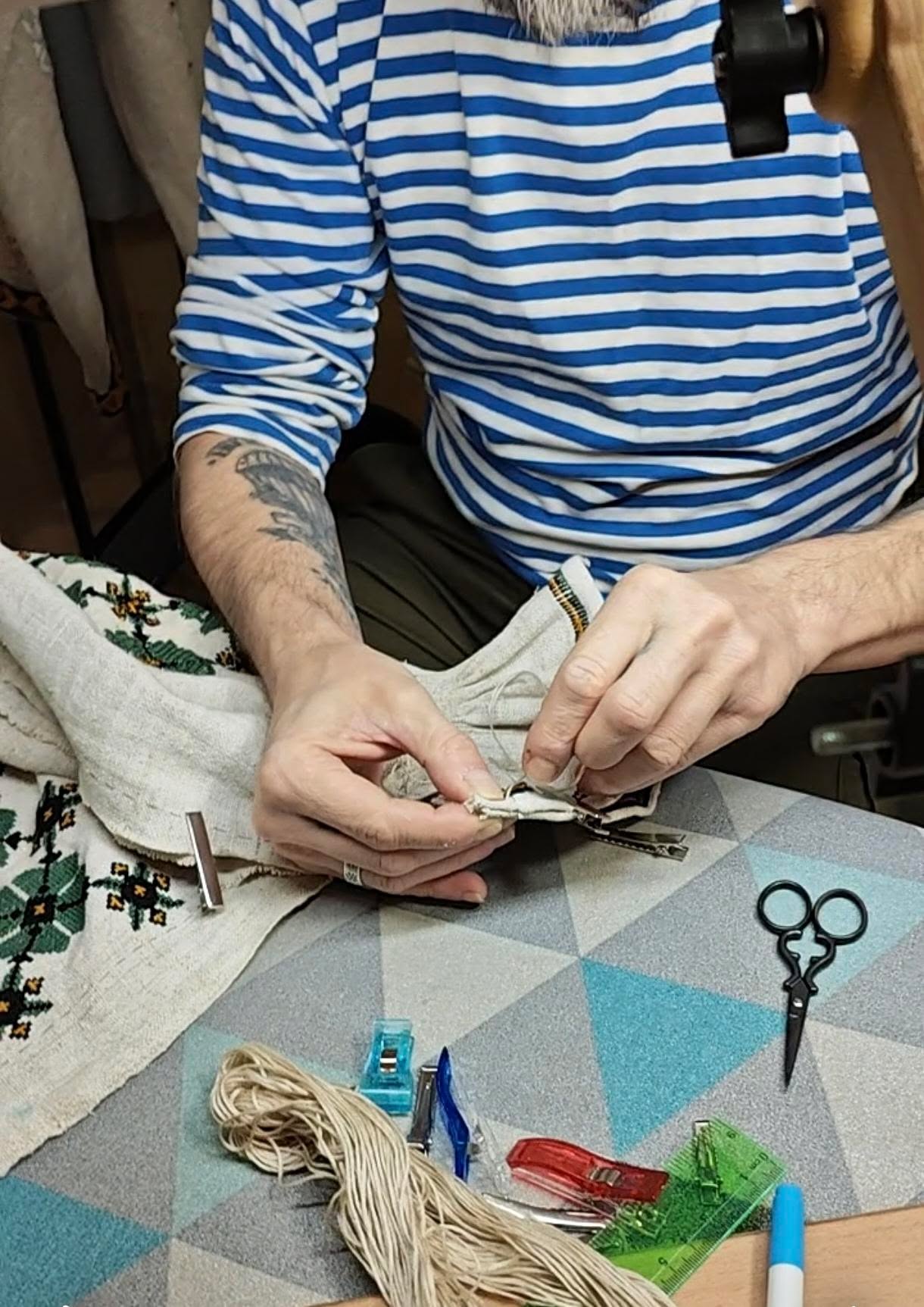
Everyone who wants to buy from us is told the story of the shirt: what fabric it’s made from, which stitches are used, how it’s cut — all the details. Yes, this has become our work now, with its own structure and schedule. It isn’t easy: sometimes your hands and eyes get tired, and the needle slips from your fingers. Then you have to take a break and rest.
I wake up around 7 in the morning and finish the day at 1–3 in the evening. My wife likes to sleep in and goes to bed earlier. But for us, it’s a full working day. We deal with work or family matters and then sit down to embroider. We consult each other about patterns, themes, stitches, and colours. In this process, we are like one whole.
It’s such a good feeling — when you start one shirt, then a second, then a third. You sell one and see that your work is valued, that people share it, talk about it. You release it into the world, instead of having those 40 shirts just sitting there, unworn.
I always say that embroidered shirts should be worn out. As soon as the weather gets warmer, you won’t see me in a T-shirt — I’m always wearing embroidered shirts, every day.
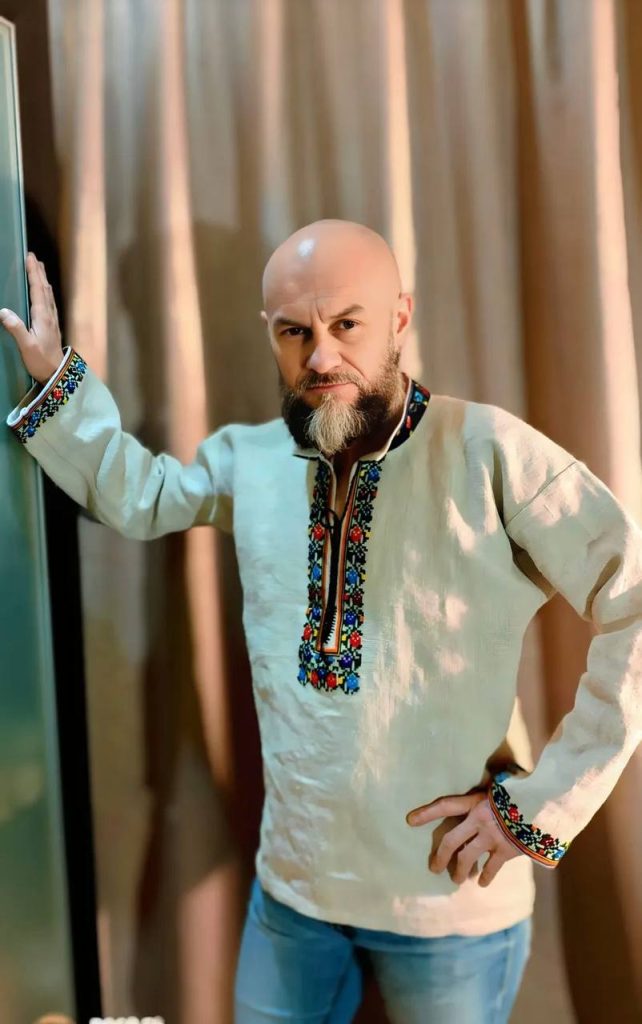
There are festive shirts and everyday ones, but that’s hard to define — it’s different for everyone. I have shirts with very minimal embroidery that are still festive. There’s one with dark brown and red thread — just two small stitches, but it made a real impression. It’s a kind of minimalism people recognise.
“I’m already back from the trenches…”
We have our own social media. I called the page “Veteran Embroidery.” I was surprised that it had over a thousand views within three weeks.
When I first started embroidering, I had all sorts of thoughts — it felt like a very unusual thing for me to do.
Sometimes people write things like: “Instead of embroidering, go to the trenches.” I don’t respond rudely, but I tell them that I’ve already been there. I try to explain that I haven’t lost faith in myself and that after the war, I want something more from life. Living with a disability, I’ve achieved things I couldn’t achieve before.
Recently, a soldier wrote to me: “Mate, this is amazing, respect, brilliant work.” And it’s not just one person. Others ask: “Could you embroider something on my military shirt?” I say: “Of course, no problem.”
Or someone writes: “I’m a serviceman too, I’m currently going through a disability assessment, I’ve lost an arm or a leg. Could you create something for my military shirt? I saw you embroidered a pattern of the Ukrainian public figure Stepan Bandera.”
I reply: “Yes, of course. What would you like?”
“I’m from an area occupied by Russians in the Ukrainian region of Luhansk. Could we come up with something? Maybe some local flowers?”
So, I create a small, delicate composition on the front, with floral elements.
Fellow servicemen are very supportive and respond in a grounded, respectful way. Some feel inspired and ask if they could try it themselves. I say: “Take a piece of fabric, I’ll send you a pattern — embroider a trident.” And then, “you can make your own patch for your unit.” It’s a form of rehabilitation, really.
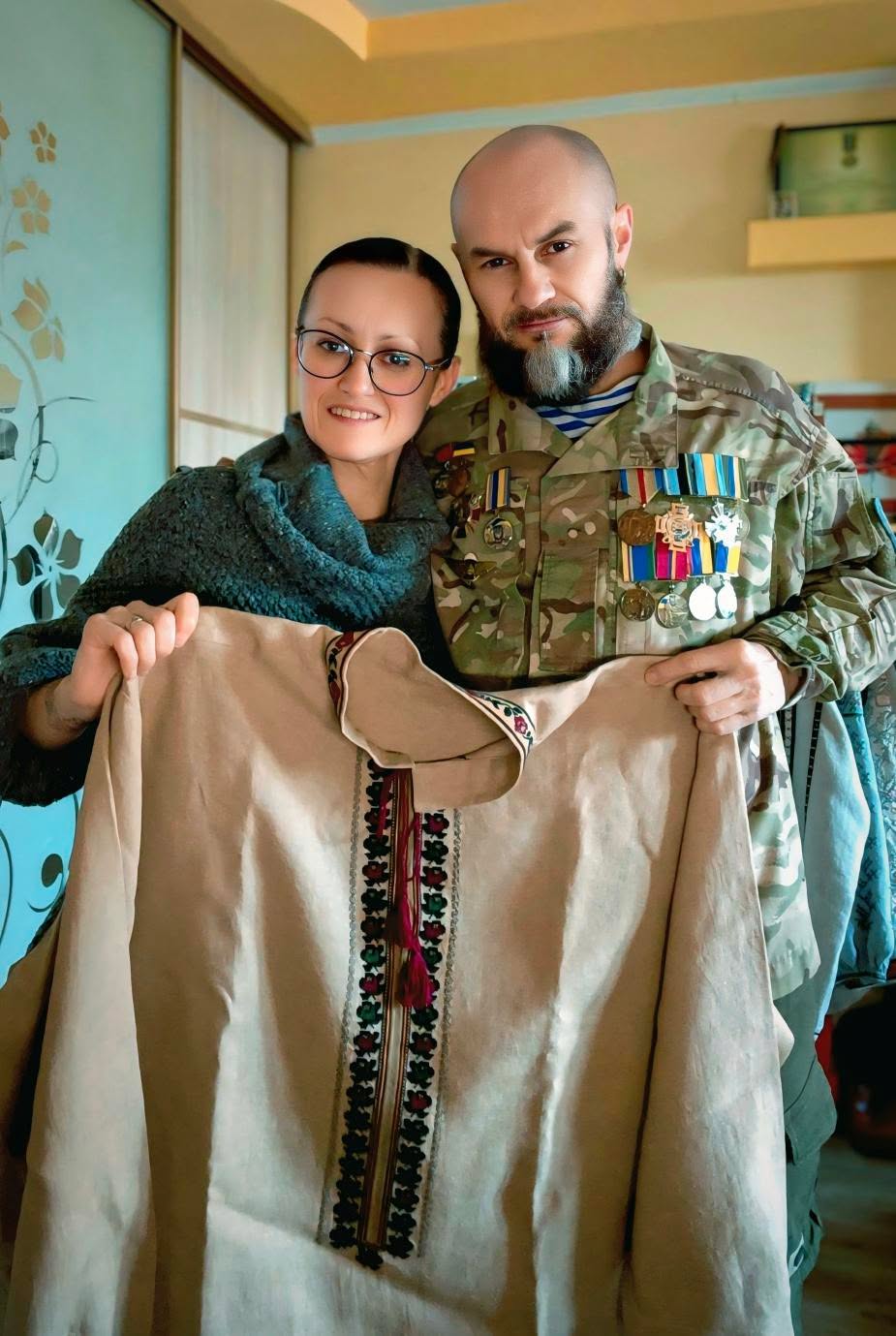
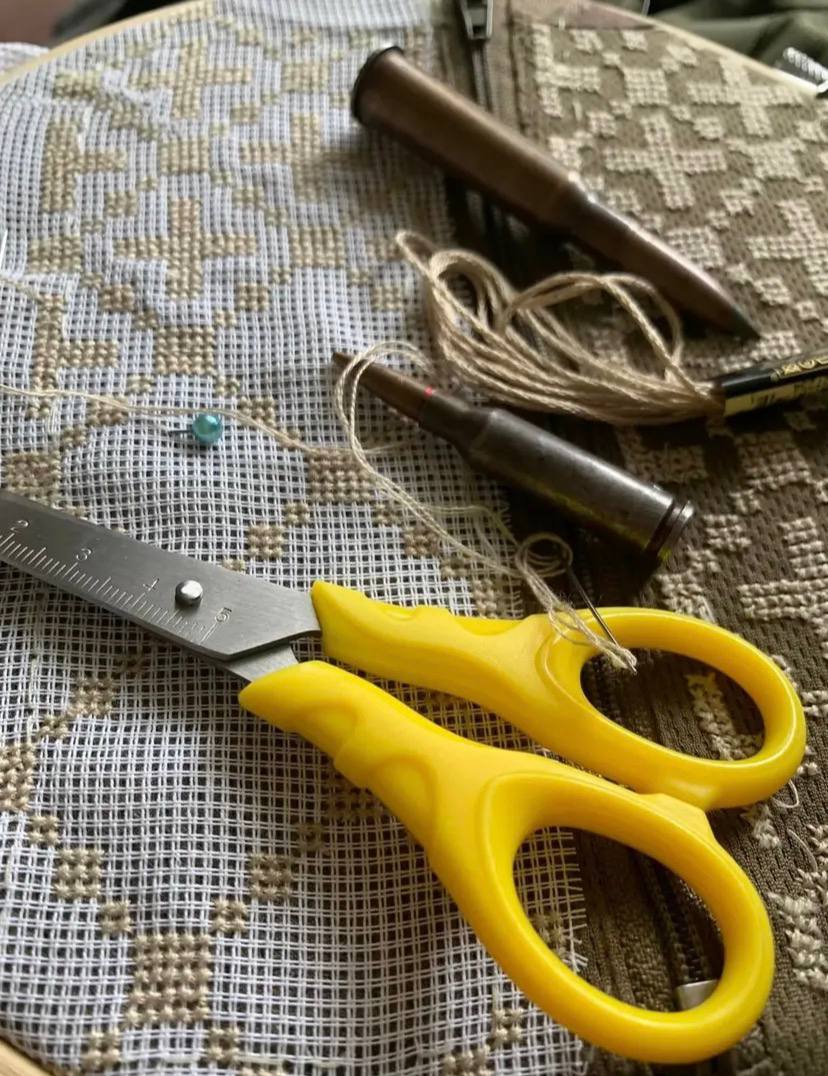
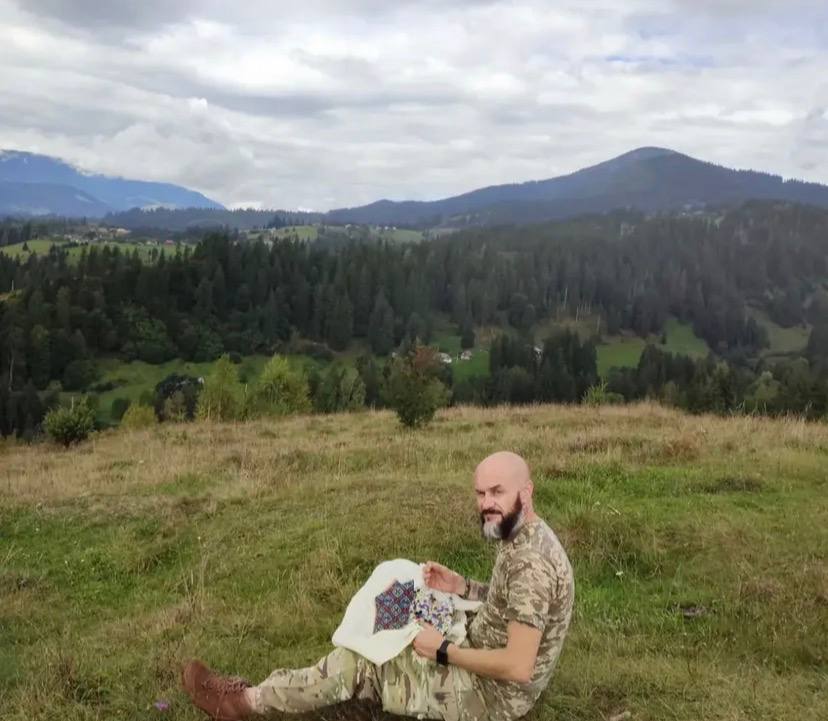
When you embroider a shirt, especially for a serviceman, you think about how they will wear it, how they will return home in it — and that everything will be alright.
A man is a protective symbol for a woman
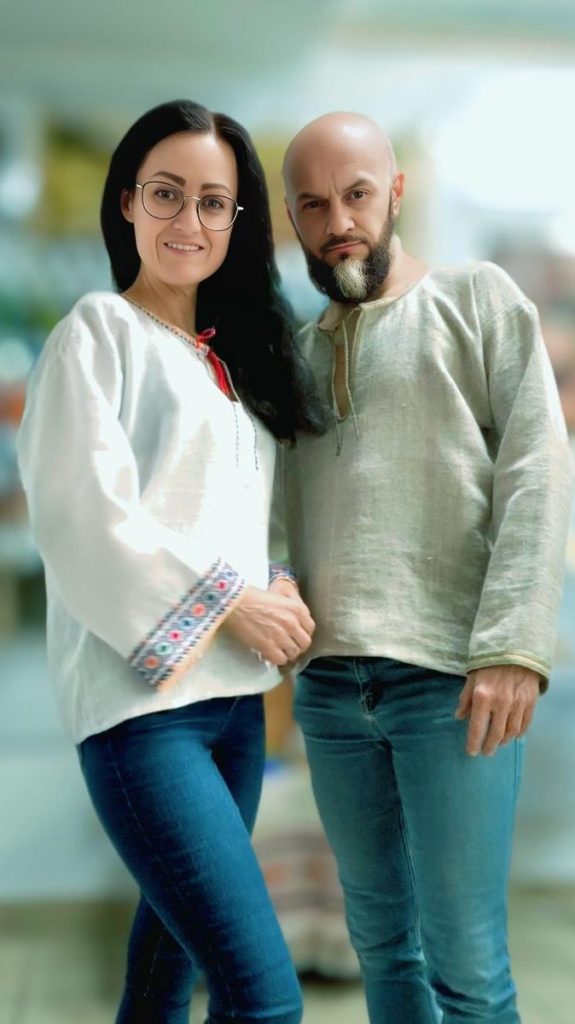
My wife calls me a sparrow. When I embroidered a shirt for her, I hid a small sparrow in the pattern as a protective symbol. Now I include it in all women’s shirts. It’s almost always the same.
When someone buys a shirt from us, I say: “Try to find the protective symbol on it.” I came to the conclusion that men’s shirts don’t need one, because a man himself is a protective symbol for a woman, but when a woman buys a shirt, she has that additional symbol embroidered into it.
My wife says to me: “One day your shirts will be in museums, or passed down through generations. They’ll be 100 or 200 years old, and people will still be finding that sparrow.”
The shirt of Taras Shevchenko
I’m very happy to have permission to recreate Taras Shevchenko’s shirt.
Even though I don’t usually repeat designs, this is a unique case. It’s the only shirt I’m ready to embroider dozens of times — maybe even more.
It was originally embroidered for him by his sister, Iryna. I recreate it only on old, traditional fabrics — hemp — and only the way it should be, with white thread. It’s a remarkable shirt.
I have one myself now. I embroidered it for myself, and when you put it on — something shifts inside you. It’s hard to explain, but the feeling is incredibly strong. It’s a very beautiful shirt.
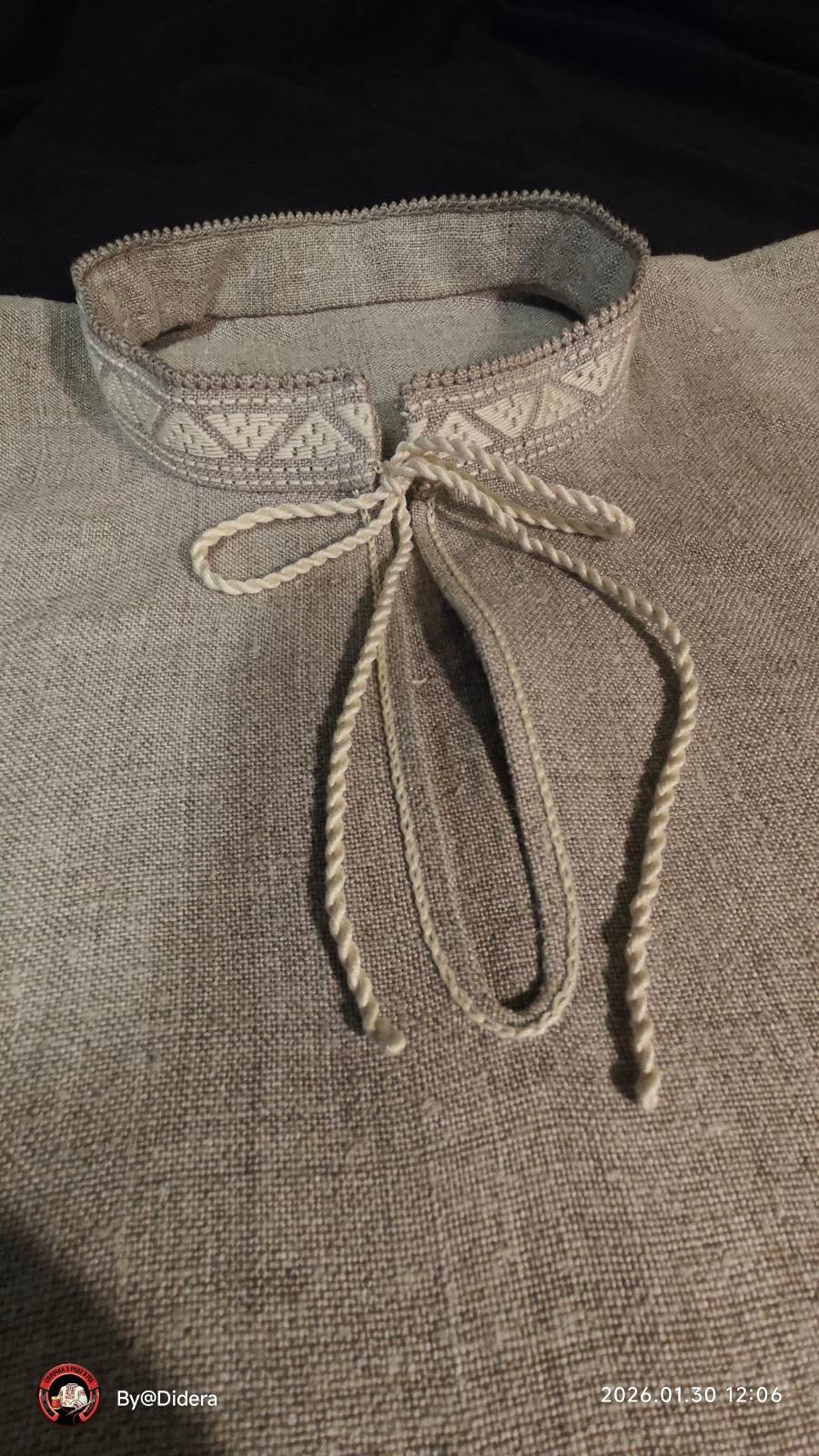
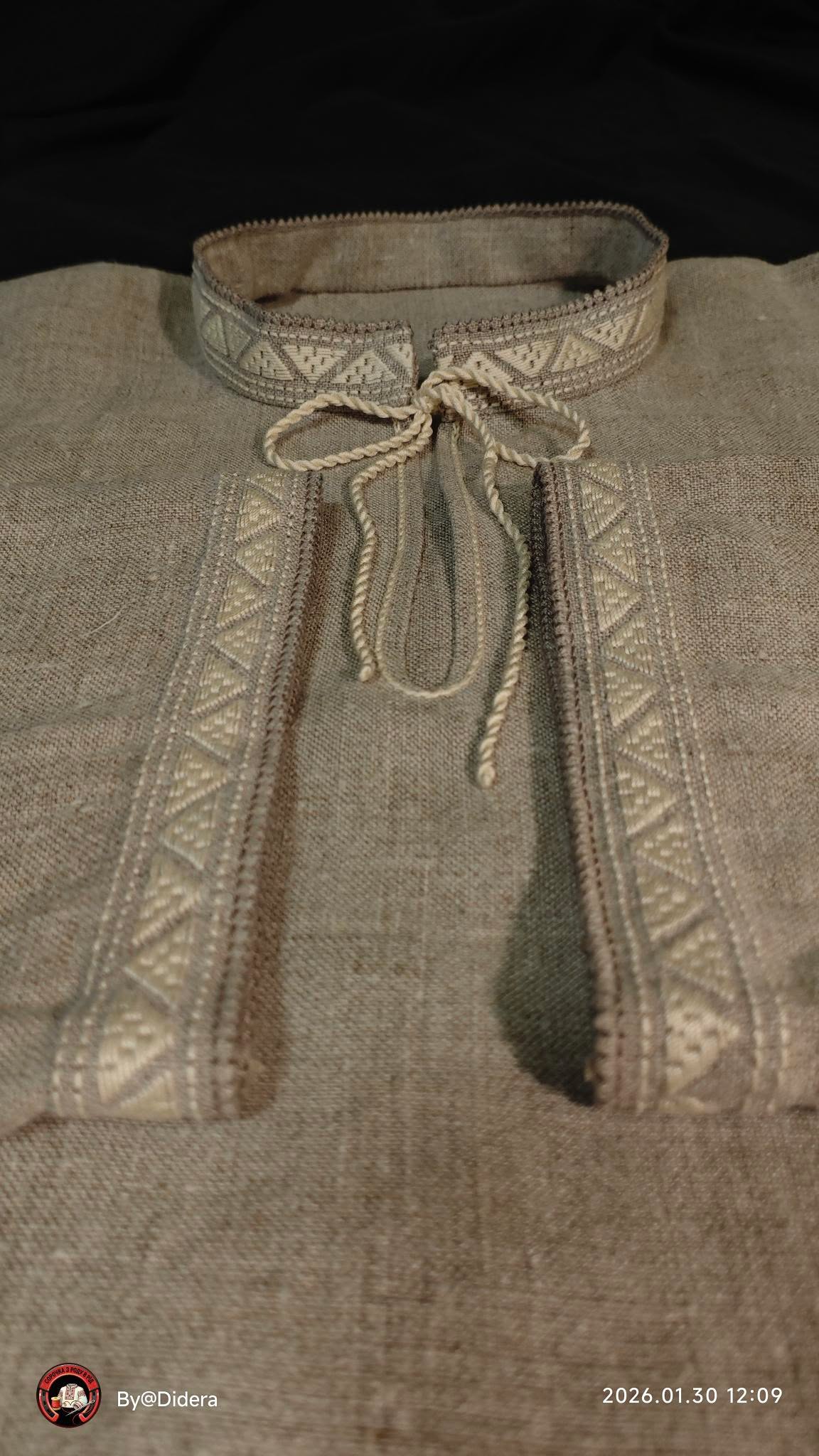
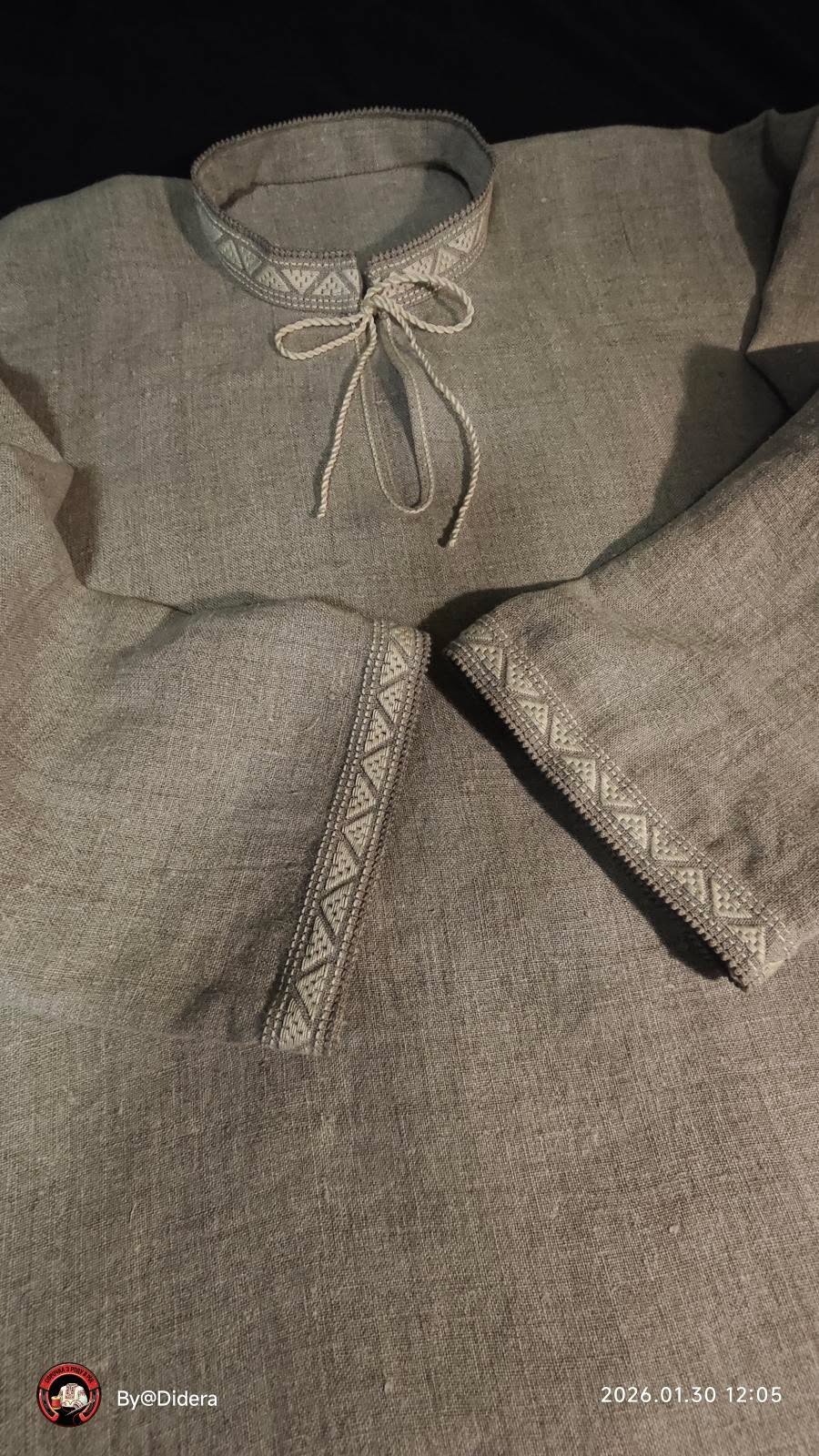
Not every rich vyshyvanka is rich because it has a lot of embroidery. You can use very few stitches, minimal ornament, just one colour — and it can still look striking and unique. You really need a sense of taste for that.
You are somewhere inside those stitches
When I embroider, I’m inside the process — inside those stitches. Someone might say something to you, you answer a word or two, and then you’re back there again.
It’s as if you’re walking along that line of stitches. You follow it from morning to evening, the same movement over and over again — and yet you’re fully immersed. It may look repetitive, but it feels like flying.
You start a shirt, make just a few stitches — and suddenly you realise it’s almost finished.
I don’t take breaks between pieces. I finish one, start assembling it — because I also assemble the shirts myself — and immediately begin thinking about the next one. When there were days when I didn’t embroider, I couldn’t find anything else to do.
Embroidery is a working routine: one stitch doesn’t fit another, so I sit, think, and adjust. I try things. Sometimes I get frustrated — it doesn’t work. Then I undo everything I spent the whole day doing. But in the end, achieve that result that makes everyone say: ‘’Wow’’.
Embroidery is for men, too
As for men who think embroidery is only for women and not for them — the kind who say “I’m off to the garage” or “I’m going fishing” — I say to my wife: “Let’s go fishing, but let’s take embroidery with us.”
Why is it that no one questions when a woman is a mechanic, or when a man cooks? Take a famous Ukrainian chef like Eugene Klopotenko — why does he cook? Because many of the most famous chefs are men. There are plenty of examples like that.
This isn’t only about embroidered shirts. If someone wants to try embroidery but feels embarrassed — and then overcomes that fear, creates a small patch for their military unit, turns a drawing into a pattern, embroiders it and wears it — others will start asking: “Where did you get that?”, and they’ll answer: “I made it myself.”
That’s how embroidery spreads. That’s how art lives on.
Many men write to me saying: “This shirt is incredible. I was looking for something like this. I’m impressed by what you do. And the fact that it comes from a paratrooper, from a veteran — that makes it even more special. It has double value.”
A lot of people say they’ve started embroidering. “If a paratrooper can do it, why can’t I?” Then they write again: “I’ve started — have a look”, and they create really good things. It’s powerful to see how people get inspired.
War and choice
I consider myself a volunteer.
In 2013, I watched the beginning of Maidan on television. I didn’t know what to do. At the time, I had two small children. The younger was two, the older had just started school. I didn’t participate in the Maidan revolution — but it stayed with me.
In 2014, I waited for a draft notice, but it never came. I didn’t want to be searched for — that would have meant criminal liability — so I went to the enlistment office myself.
Before that, from 2001 to 2003, I had served under contract in air defence, as an operator of a surface-to-air missile system. At the enlistment office, they told me that my unit had been disbanded — which meant, on paper, I didn’t exist.
They suggested opening a new file and sending me on a medical assessment. The next day, I went to the Rivne training ground, then Zhytomyr, then the 95th Brigade.
I went voluntarily, and I don’t regret it for a single moment.
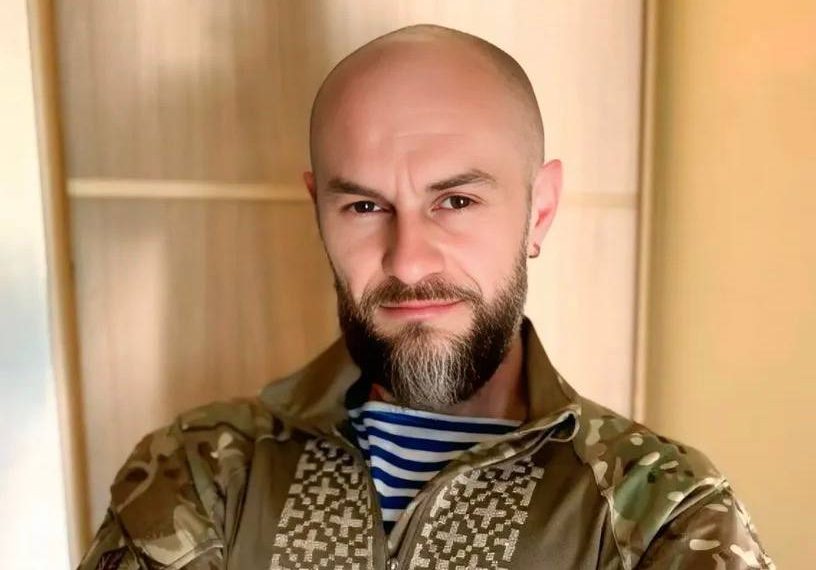
For a year, we were a fire support group, moving across Donbas wherever it was most needed – it was intense.
When people said: “You’re a machine gunner, where are you going?” I would say: “I used to hide at the back of the classroom when I was in school. Now I’m paying for that — with blood. Now I’m the first to raise my hand.”
And that’s how it always was — wherever I needed to be, I was there.
Adapting to war — and stitching peace
Adapting to war was difficult — but only until the first shelling. You don’t know what it will feel like, but when the mortars start… you realise quickly.
Before the war, in civilian life, people say: “I would do this, I would do that.” But in reality, you hide under an APC, place icons beside you, and pray. That’s what it really looks like.
Then it happens again, and again — every day, without warning, and once you adapt, silence becomes the difficult part.
When shelling starts, you work. You joke — because without humour, you can’t get through it. You feel alert, present.
And after the war… the war doesn’t leave you. It never will. My wife never asks questions — only when I’m ready, I speak, because I think about the war all the time. On the way to buy threads, in traffic, before sleep, watching films, embroidering — it’s always there.
When I embroider, I think about peace. About beauty. About a victory that I hope will come soon. I stitch those thoughts into the shirt.
Embroidery as calm, work, and self-development
For me, embroidery is calming. It is my work, my joy, time with my wife, and self-development. I keep learning, growing, even though I only discovered it at 44 years of age.
Maybe that’s why I chose the name “A Shirt Passed Down Through Generations.” Maybe one day one of my sons will take an interest. Maybe not embroidery itself, but something connected to it.
I’m certain this will continue. These shirts will be passed down through generations. They have a future.
It’s important that embroidery hasn’t disappeared — on the contrary, during the war, many more people have started doing it.
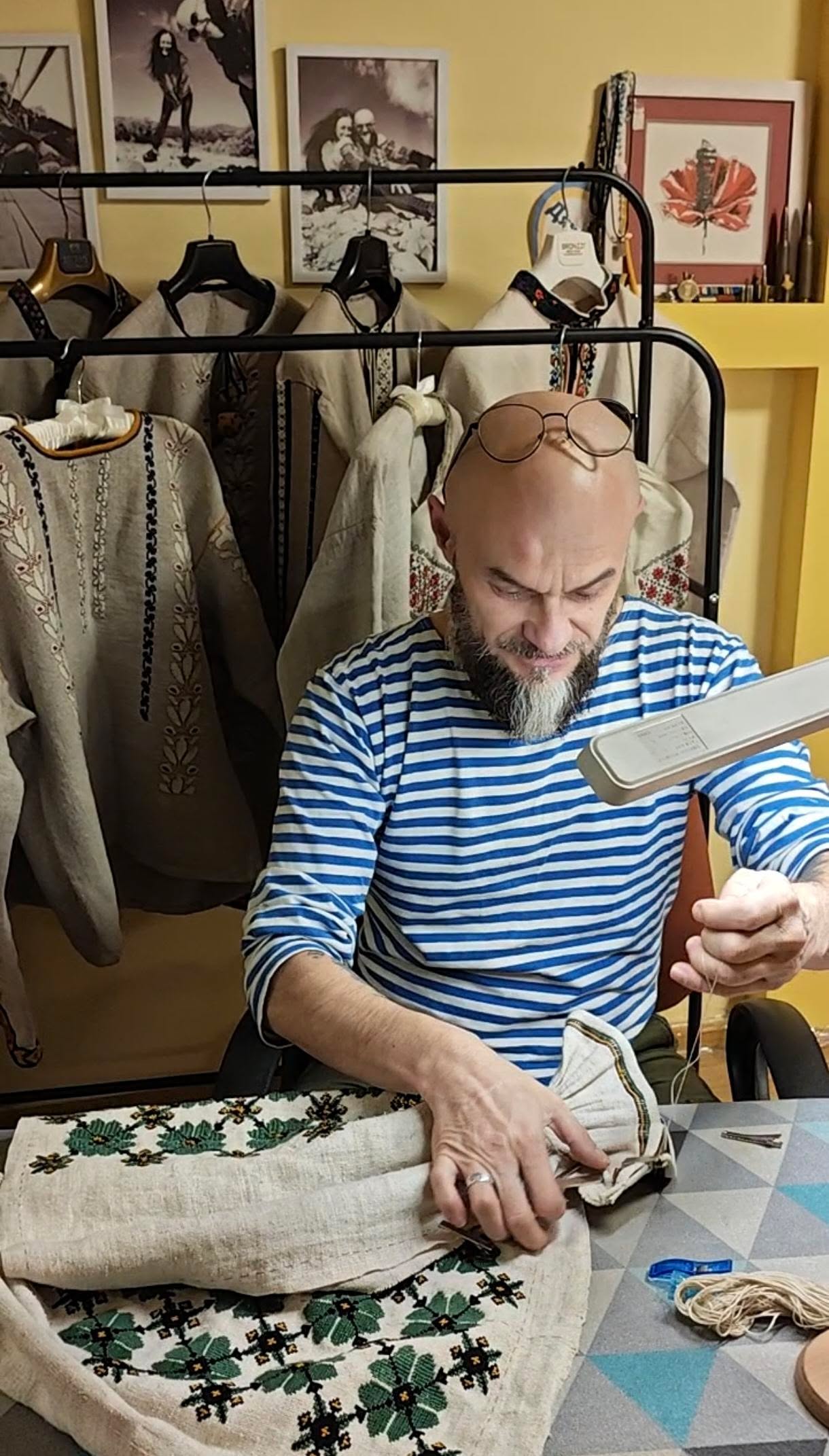
People write asking to learn, to be shown how, and of course, I share—I record short videos and explain things.
Some shirts are made by my wife, some by me, some together. We always share this, because the person buying the shirt should know its story.
Sometimes I film the whole process — from the first stitch to packaging — showing how the sleeve, collar, and front parts are embroidered and how it all comes together. I send it to the client, so they have the full story of their shirt.
How to order a shirt “passed down through generations”
The easiest way is to message us on Facebook, Threads, or Instagram.
You can ask questions, discuss ideas, or place an order. We always reply on social media.
Text: Svitlana Pylypchuk
English version text editor: Helen Lewis
Ukrainian version text editor: Anastasiia Zanuzdanova
Photos from Roman Didera’s family archives.