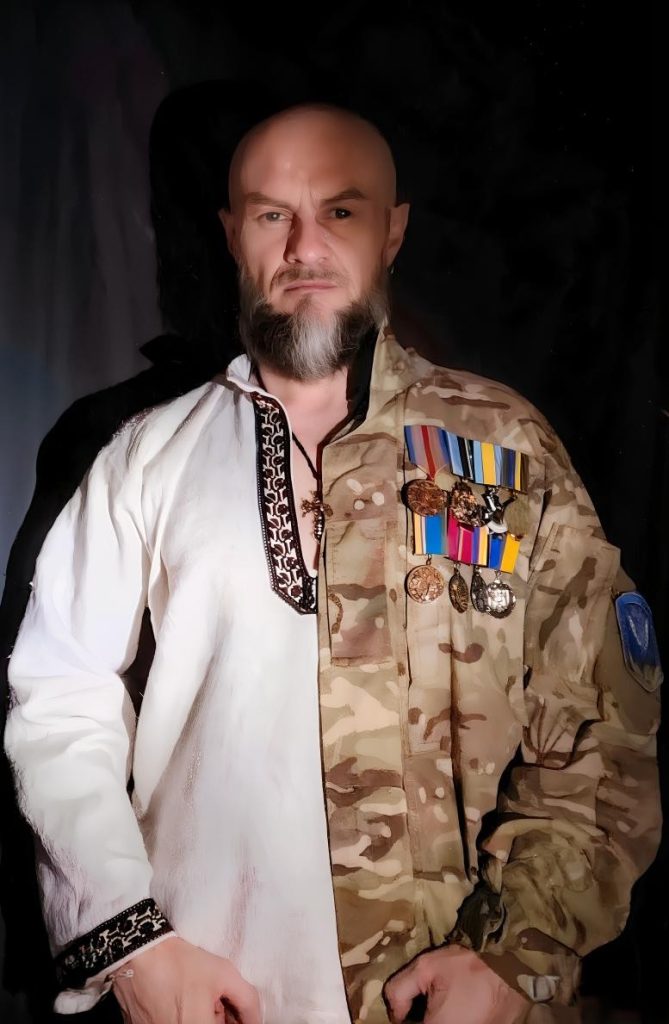
Many of the most meaningful changes in the world come from the initiative, compassion, and persistence of ordinary people. Their influence often works like invisible threads — quietly touching lives, building trust, and helping others. Even if people do not always see or understand the true scale of this impact, the important thing is that good work continues.
This article tells two stories of people and projects that put humanity at their heart: the First Volunteer Surgical Hospital in Ukraine, and the bilingual Ukrainian–English publication Maiak Lighthouse Media CIC.
Stanislav Onyshchuk, founder of the First Volunteer Surgical Hospital:
‘… I did everything I could think of…’
Rostyslava Martynyuk, founder of Maiak Lighthouse Media CIC:
‘… I do what I can to be useful…’
Together, their stories show the value of partnership.
Stanislav Onyshchuk
Stanislav first stepped into entrepreneurship in 2006, while also being active in community life. By 2014, he had opened a cosmetology clinic. Later, through a grant and cooperation with the German SES programme, he launched a plastic surgery hospital in Ivano-Frankivsk in 2023.
When Russia’s full-scale invasion began, he transformed this hospital into the First Volunteer Surgical Hospital. From then on, it operated entirely voluntarily.

By January 2024, the project had evolved again — this time into the City Rehabilitation Centre. A month later, a Veteran Hub was opened, creating a dedicated space for veterans. That same year, fairs for self-employed veterans were launched, along with the Bureau of Stories, a platform for sharing personal experiences.
A rough idea that grew into a lifeline
In January 2022, just weeks before the invasion, Stanislav had completed a civil defence course, ‘Don’t Panic — Prepare’, organised by the local Azov branch.
“My mother-in-law was the first to tell me the war had started. Planes flew all night long. My phone rang constantly with calls from colleagues and friends. Driving through the city, I saw smoke hanging over Ivano-Frankivsk after the shelling. The streets were empty, the wind blew plastic bags along the ground. It was the most shocking day of my life. But I was prepared.”
That evening, Stanislav and his colleagues gathered at the clinic. Two choices stood before him: join the Armed Forces, or reconfigure the clinic’s work to meet the urgent needs of the war.
He already had a licensed medical facility, a trained team, premises, and resources. The rough idea was simple: turn it all into a hospital for the wounded. “Such humanitarian work,” he thought, “would have a greater impact”
From idea to reality
The first step was convincing German partners — whose grant had helped establish the clinic — to support the transition. They agreed. The next was to ensure the project would genuinely serve the military.
Azov fighters confirmed there was a need, even if the facility was small — just seven beds at the time. They trusted Stanislav, not only as a doctor but as someone who had trained with them.
Still, the biggest challenge remained: people. “Equipment and buildings mean nothing without qualified staff,” he explained.

So, he made a Facebook post calling for volunteers.
“I remember well writing that post one evening and going to bed without much hope. By the next morning, I had nearly 200 messages and calls from doctors across Ukraine — Kyiv, Kharkiv, Irpin, Zaporizhzhia. They offered their time and skills, free of charge. At that moment, the idea became real.”
By 7 March 2022, the first strategy meeting was held. On 15 March, the hospital admitted its first wounded soldier.
Building a team and a community
“Over time, we grew from seven beds to ten, then twelve. Today, we can treat fourteen soldiers at once. The team worked without pay, without days off. Some doctors even lived in the hospital — sleeping upstairs, operating downstairs.”
Local schools helped by preparing meals and providing accommodation. Volunteers without medical training contributed too — chopping firewood, cleaning, or simply lending a hand where needed.
A Czech technology manager even flew in to spend his holiday volunteering. Afterwards, he admitted he wasn’t sure who had gained more — the hospital or himself.

Fighting to survive
Despite its success, the hospital constantly faced financial difficulties. By summer 2022, debts were mounting. “Either we found funding, or we closed,” Stanislav recalls.
That summer, they secured a grant. Doctors Without Borders also joined, and for the first time, the hospital could operate without debt. Eventually, the team even began to receive modest salaries.
However, by late 2023, all funding programs had ended. Once again, the future was uncertain.
“In January 2024, I asked the staff to continue voluntarily for two weeks. At the same time, I approached the city mayor with a proposal: turn our hospital into a municipal rehabilitation centre. Ivano-Frankivsk, the city we located in needed one. We already had the equipment, the team, and could treat around 20 soldiers a month.”
The hospital was on the brink of closure when, on 15 January, the city officially agreed to take it under its care. Five days later, the project was awarded the Bohdan Hawrylyshyn Prize.
What had started as a rough idea in a moment of crisis had now become a permanent part of the city’s healthcare system.

A mission that continues
The original cosmetology clinic — which had served displaced civilians after the invasion — could not survive financially and closed in late 2023.
But Stanislav remains pragmatic:
“Today, there is a private medical facility there. It still continue helping people. In the end, what matters is not who runs it, but that it fulfils its mission.”
It is important to heal the person, not just the wound
Stanislav explains that the hospital is not only about treating physical injuries, but about understanding the whole person and their needs. One of the most critical elements, he says, is the atmosphere.
“The point is not just to heal an arm or a leg, but to heal the person. It’s also about invisible things. It is essential for a person to feel that they belong, that they are needed here, and that they can express their needs, while also feeling safe.”

This understanding led to the idea of creating a Veterans’ Space — a place where service personnel and their families can socialise and receive non-medical support, from family psychologists to logotherapists.
“I approached the mayor with a proposal to create a municipal veterans’ space. Our team already had experience in psychological and social work with former soldiers and their families. We wanted to take this to a larger scale. To provide full support, we needed to expand both our space and our reach.”
Within a year and a half, the space was ready. In February 2024, the Veteran Space opened its doors. It now hosts self-help groups, psychological and psychiatric support, family therapy, art therapy, and regular meetings for bereaved families with clergy. In summer, camps are organised for children of serving personnel and for children who have lost parents in the war. With help from local authorities, families can also secure places in kindergartens for a few days each week.
“Understanding the need for socialisation and reintegration, we work with the Centre for children deprived of parental care. We arrange meetings between children and military personnel. This has proved invaluable. Children need examples of courage and resilience. At the same time, soldiers need to be seen as heroes. When they speak here, their experiences are inspiring, not frightening.”
Branching out and cooperation
Caring for veterans and their families soon grew into something larger. Stanislav and his team realised how important it was to bring veterans together and help them connect.
In 2024, they began organising fairs showcasing the work of self-employed veterans.
“Many people whose lives we have touched have their own small businesses or hobbies. Some work with clay or leather, others with food products — all of them are local craft producers. Since 2024, we have organised four fairs. The first had only a handful of participants, but the most recent had 23 craftspeople from across Ukraine.”
These fairs became places for veterans to share experiences, present their skills, form new partnerships and friendships.
“This is not about medical care or our direct work as a surgical hospital. But it complements our mission — it is an extension of our support for those who defended us. Such events help small businesses grow, empower people, and strengthen communities.”
Story bureau
Soon after the fairs began, another idea emerged: to record the stories of those the hospital had supported.
“Every person has an extraordinary story. We thought it would be great to preserve them, alive and immediate, with their emotions and meanings at that very moment. Over time, people tend to forget details, but capturing them as they happen makes them more vivid. These are stories about motivation, family, and the reasons to live. Sometimes a single phrase can change you.”
This became the Story Bureau.
“It is not our primary mission — our focus is still the treatment and rehabilitation of wounded soldiers and civilians. But the Story Bureau is a by-product that matters to society. It is a living record of how people endure, adapt, and find strength.”
How to get treatment and rehabilitation
Assistance can be requested via the online form or by calling the number on the hospital’s website. Current service personnel need a referral, which can be arranged over the phone. For veterans, registration online is enough. Location or background does not matter — support is available to anyone in need.

Information partnership
Stanislav explains that the hospital’s partnership with Maiak Lighthouse Media CIC began long before the war.
“We knew Rosa, the founder of Maiak, from public sector work. We met often at social and cultural events. The war took us in different directions, but we stayed in touch. When she reached out about collaborating, I agreed immediately. I knew the partnership would be valuable.”
He stresses that the cooperation goes beyond formal ties.
“Cooperation doesn’t always have to mean direct results. You don’t have to volunteer at our hospital to work with us. What connects us is people — they are the heart of everything we do. Both Maiak and the First Volunteer Surgical Hospital are about people, their stories, their journeys. It’s about partnerships that make good things possible for people who, otherwise, might never have met, discovered their potential, or found healing. To speak openly about how you see the world, and to find like-minded people through that honesty — that’s what we have in common.”

Rosa: faith in people and stories worth telling
Rosa recalls:
“A few years ago, a mutual friend introduced us. We were all a little dreamy and idealistic, working in related fields. What united us was wanting to help those in need. Stanislav was in business; I worked for a charity and was active in the community.
He was always smiling and warm. Once, at a cold outdoor event, he simply bought coffee for everyone without a word — just to make sure we were comfortable. Another time, I bumped into him while running errands. He told me he had a meeting with foreign partners in an hour, and insisted I come along, saying it would be helpful. He was direct, generous, and always ready to share with others.
Later, the charity where I worked closed down. We were exhausted, but Stas and I stayed friends. Even when war scattered us across the world, that didn’t change.
I deeply admire him and his projects. His enthusiasm, determination and sincerity are rare. What he and his team are doing requires great inner strength, willpower and patience.
Our projects share a commonality in that they are people-centred. We both believe that everyone has a story worth telling, something unique to share with the world.”
Author: Svitlana Pylypchuk
Ukrainian language editor: Anastasia Zanuzdanova
English language editor: Helen Lewis