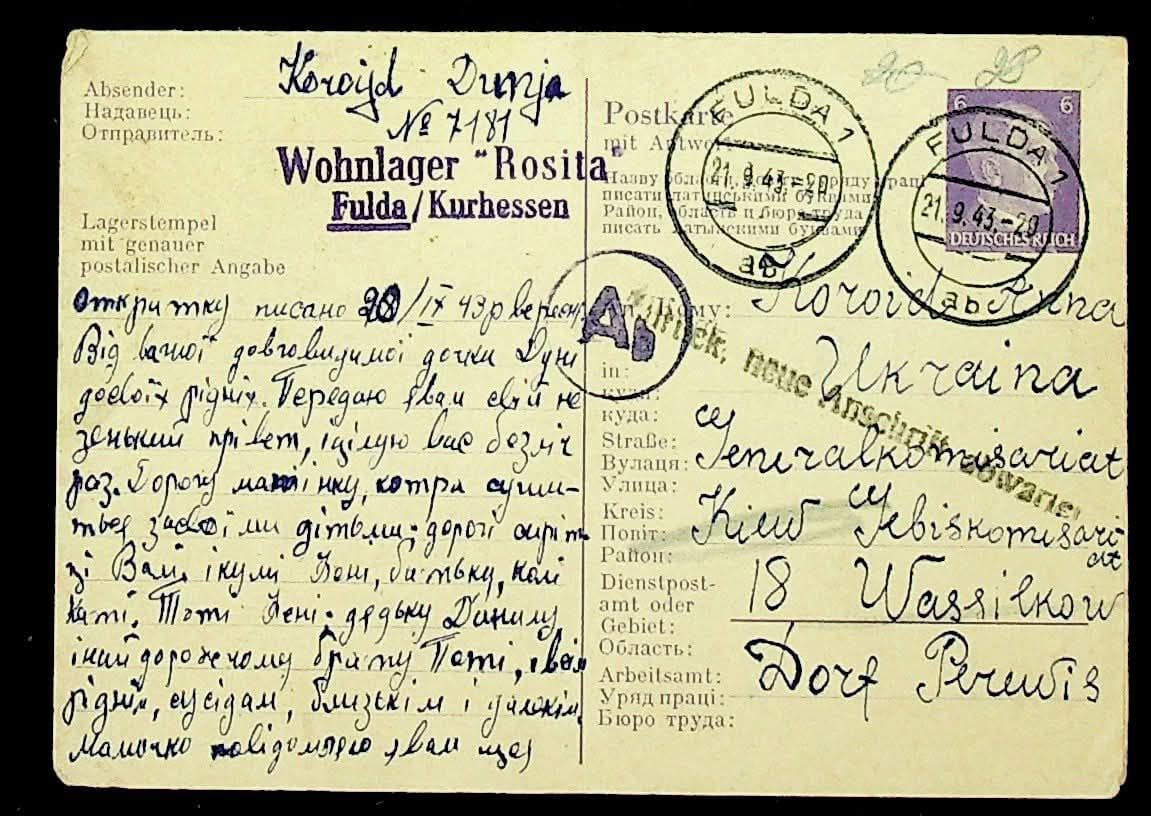
Volunteers in the Kyiv region have returned the first 4,000 out of 50,000 letters sent to the descendants of former forced labourers by their relatives from Nazi Germany in the 1940s – letters that Soviet security services once seized from post offices and locked away.
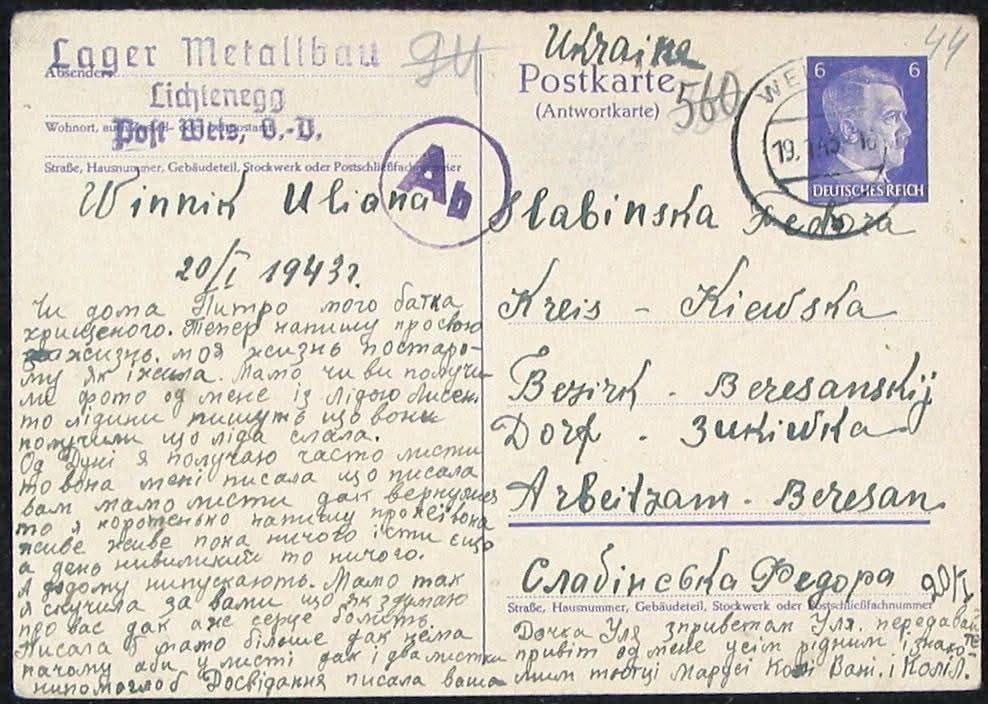
“Good day, my dearest and unforgettable mummy. Before writing you this short letter, I hasten to let you know, Mum, that I am alive and healthy, and I wish the same to you. I send you my heartfelt greetings and wish you, Mum, peace and well-being in your home life. Mummy, I received two of your letters and thank you very, very much for not forgetting your poor orphan daughter in a faraway foreign land… Mummy, don’t grieve over me – I am alive, and everything is as before. Rather, take care of yourselves; I am so sorry for you from so far away. I grieve for you too, Mum, that you are so unhappy, left old and alone, with no one to comfort you… Mum, don’t send me anything. The winter here is mild; they gave me clothes – the dress is torn, the skirt poor, but the shirt is new. I have written to you every week, sometimes twice a week. Each time I write to you and to my in-laws, and I have sent photographs, though I don’t know whether you receive them or not.”
This is an excerpt from a letter written by Ulyana Vynnyk, a Ukrainian Ostarbeiter (forced labourer), to her mother Fedora Slabinska, in the village of Zhukivka, Kyiv region. The letter is dated 3 February 1943.
Tragically, Fedora Slabinska never received a single letter from her daughter during her lifetime. These words were read 82 years later for the first time by Ulyana’s granddaughter, Viktoriia Hnatiuk.
Thanks to Vitalii Hedz, Director of the Makariv Local History Museum, Viktoriia, along with more than three thousand other descendants of forced labourers from the Kyiv region have now received copies of letters written by their relatives. At the time, these messages from captivity never reached their addressees because the Soviet repressive system intercepted them: security services “arrested” the mail at post offices and sent it for secret storage to the Kyiv State Archive. Carelessly dumped into sacks, thousands of letters lay there for decades while families waited in vain.
 Seized for Decades
 Seized for Decades
“After Kyiv and the surrounding region were liberated from Nazi occupation, all correspondence found in post offices was inspected by officers of the People’s Commissariat for Internal Affairs – in other words, censored,” explains Sofiia Kameneva, Director of the State Archive of Kyiv Region.
“After censorship, the letters sent by forced labourers never reached their intended recipients. They were transferred to a secret department of the regional archive. At that time, archival institutions were part of the NKVD system. The letters remained in the same packages and sacks in which they were collected twenty years earlier. Only in 1963 did work begin to organise them geographically – by districts and settlements.”
According to Kameneva, the original title of the archive collection was ‘Letters of Soviet Citizens Deported into German Slavery’. Over subsequent decades, the collection was supplemented with documents from archives in other regions, including Zhytomyr, Poltava, Mykolaiv, Chernihiv and Cherkasy.
The entire collection has been classified. Information about it was unavailable to the public; in effect, the documents themselves were ‘under arrest’. Only in October 1988, following an order from the Main Archival Directorate of the Ukrainian Soviet Socialist Republic, was the collection transferred to open storage.
Thus, the documents – living testimonies of people forcibly taken to Nazi Germany – were finally made accessible.
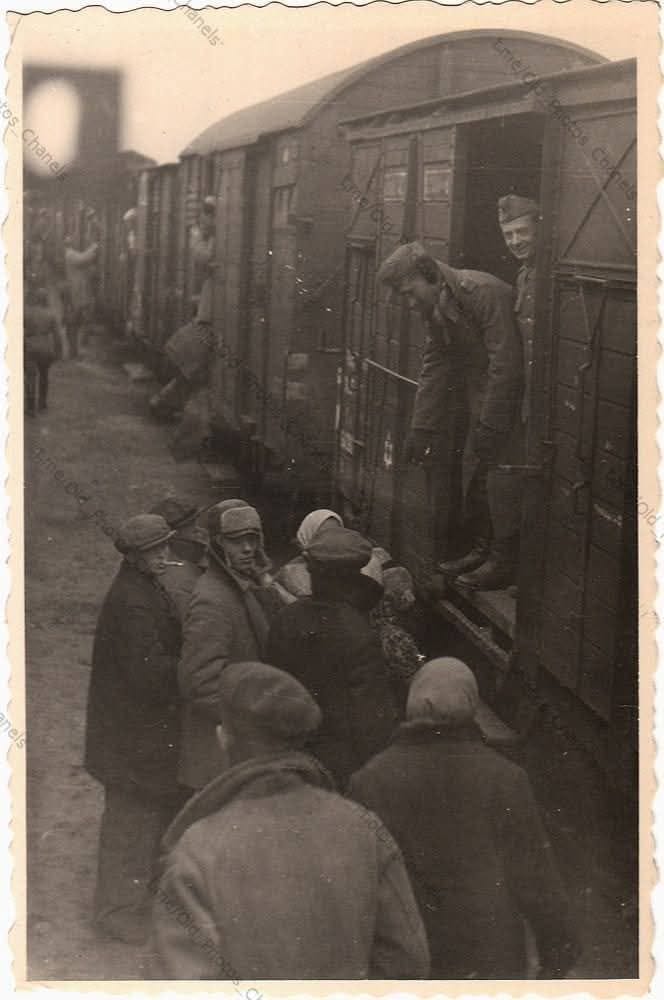
It is difficult to believe, but by the early 2000s, the State Archive of the Kyiv Region held around 50,000 letters from Ukrainian forced labourers. Most were postcards with stamps – the only form of correspondence the Nazi authorities permitted enslaved workers to send home. Yet the Soviet regime, having branded all former Ostarbeiters as “enemies of the Soviet Union people”, deprived them of the chance to send news of themselves – often the only lifeline to their families.
A 75-Year Journey to the Addressee
Among these messages from captivity was a postcard sent by Vitalii Hedz’s great-aunts. He had long sought traces of their fate: one never returned from Germany, while the other came home gravely ill and died six months later.
In spring 2018, Hedz learned from colleagues that the Kyiv regional archive held letters from forced labourers from the Makariv district. He immediately travelled there.
“When they brought me a folder, and I saw the name of my native village, Kalynivka, on it, I opened it, and inside was a letter and a photograph from my relatives,” he recalls.
“I was allowed to photograph it. I showed the image to my mother, and she burst into tears – tears of joy. Seeing her reaction, I realised how many people are still waiting for these letters; and how many would receive them with gratitude?”
It turned out that the archive held more than 1,000 undelivered letters from the Makariv district alone. In May 2018, with the support of the archive’s management, Hedz launched a volunteer initiative titled “Unsimple Letters”, aimed at locating descendants of those deported for forced labour.
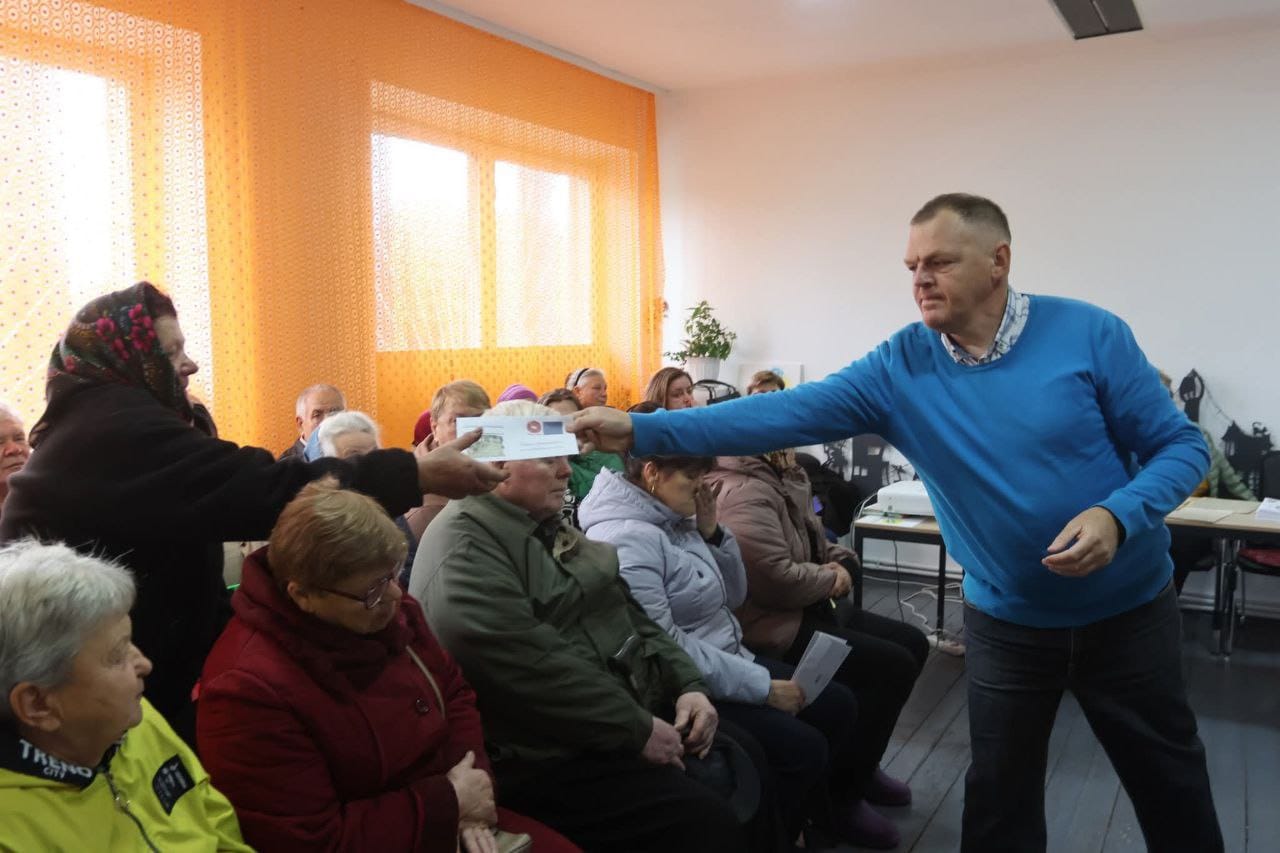
He worked with schools, village councils, and cultural centres, whose staff helped organise public ceremonies where families received copies of the letters. Gradually, the district initiative expanded to cover the entire region.
Before the COVID-19 pandemic, around 3,500 letters had been returned to descendants in the Kyiv region. Remarkably, seven letters were handed to their original authors, who had survived, returned home from Germany and lived in Ukraine.
 From its inception, the project received financial and technical support from the nationwide initiative Memory of the Nation, then led by historian, activist and television presenter Oleksandr Alfiorov, now Head of the Ukrainian Institute of National Memory.
“All stages of this project — from locating documents, to deciphering and returning them — are vital pieces in the mosaic of researching the history of the Second World War and occupation regimes,” Alfiorov notes.
“To see children and grandchildren receive these letters as a tangible connection to their ancestors is an emotionally powerful experience of historical discovery.”
Two Hundred Messages Return to Zhukivka
Due to the pandemic and the outbreak of Russia’s full-scale invasion of Ukraine, the project was temporarily paused. It has now resumed. This autumn, 211 letters were returned to descendants in the village of Zhukivka, part of the Zghurivka community.
“This is already the third settlement in our community where letters have been handed over within the ‘Unsimple Letters’ project,” says Larysa Melnyk, Deputy Head of the Zghurivka community.
“Vitalii Hedz is doing significant work. These documents are fragments of our history, of our shared memory. During the Second World War, around 2.4 million young Ukrainians were deported for forced labour. Not all of them returned. Each letter is not merely a document, but a human fate filled with pain, faith and love.”
Among those receiving letters was Viktoriia Hnatiuk, a local administrative officer. With trembling hands, she holds the letters and photographs her grandmother, Ulyana Vynnyk, sent home.
“In 1942, my grandmother Ulyana and her elder sister Dunia were taken for forced labour,” Viktoriia says through tears.
“They both returned in 1945 and passed through Soviet filtration camps. These eight letters were delayed for 82 years. During her life, my grandmother rarely spoke about Germany. Only now, through these letters, have I understood how hard it was for her. Yet she pitied not herself, but her mother, left alone by the war, daughters deported, son missing. Everyone is gone now. Holding this letter felt like speaking to her again.”
A Documentary Film and an Award
During the event in Zghurivka, organisers screened the documentary film “Unsimple Letters”, which tells the story of the project and of Mariia Harkavenko, a former forced labourer, who received three of her own letters on her 100th birthday in 2020.
“The idea for the film emerged in 2019,” explains director Mariia Yaremchuk.
“Our team, Sector of Truth, produces investigative historical documentaries, working closely with archival documents and original materials. When we learned about this project, we began filming the letter handover ceremonies. Watching people read these letters aloud, unable to hold back tears, was deeply moving.”
In 2023, the film won Best Historical Short Film at the IX International Historical Film Festival Beyond Time
 Research continues. In 2023, the archive completed a renewed systematisation of the letters, improving descriptions to prepare them for digitisation. Future plans include researching Ukrainian forced labourers in German archives and producing a feature-length documentary.
Through this work, says Yaremchuk, the team sought to focus attention on civilians – the most vulnerable victims of any war – and to draw parallels with Russia’s current war against Ukraine. According to official data, millions of Ukrainian civilians have been forcibly deported from occupied territories.
Do they write letters to their families?
The question remains rhetorical.